Liner Notes
How to Qualify a New Label Supplier Under cGMP
Qualifying a new label supplier is less about finding a printer with the right certificate on the wall and more about confirming that the supplier can show how your labels are controlled from approved artwork through production, inspection, shipment, and reorder.
Your supplier-qualification procedure belongs to your own quality system. The label printer’s job is to make that process easier by arriving with documented procedures, traceable production records, retained samples, change controls, and clear answers about how printed labels are handled.
For quality and procurement teams, the practical question is straightforward:
Can this supplier show us how an approved label becomes a repeatable production job (and what happens when something changes)?
That is the standard the rest of this article uses.
Printed labels deserve tighter control than ordinary packaging
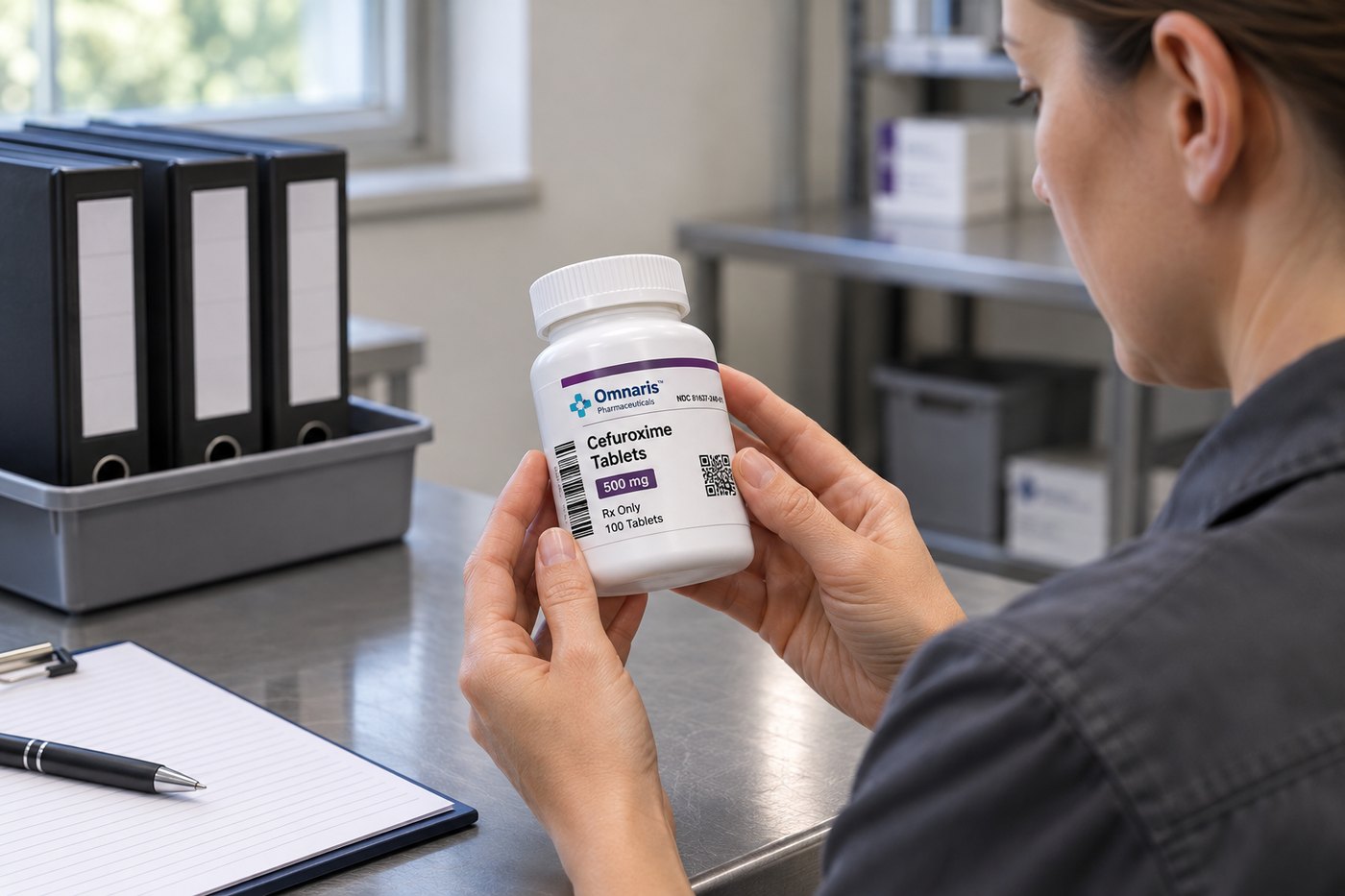
A roll of labels may arrive like any other packaging component, but the consequences of an error are different. The wrong version, lot information, barcode, or approved copy can move directly onto the finished product.
That is why regulated manufacturers control labeling through approved specifications, issuance, reconciliation, inspection, change control, and production records. A new label supplier should be able to support those controls with evidence from its own system.
Exactly which requirements apply depends on what you manufacture:
- Drug manufacturers operate under 21 CFR Parts 210 and 211, including specific controls over labeling and packaging operations.
- Dietary supplement manufacturers follow the packaging and labeling requirements in 21 CFR Part 111.
- Medical-device manufacturers operate under FDA’s Quality Management System Regulation in 21 CFR Part 820, which now incorporates ISO 13485:2016 by reference.
For a separate look at the content side, what belongs on a medical or pharmaceutical label and who is responsible for deciding it, see our guide to what belongs on a medical or pharmaceutical label. Bottom line, your label supplier should be prepared to show how its own controls support your approved process.
Seven areas tell you whether a label supplier is ready for qualification
Most label-supplier qualifications touch the same core areas:
- Supplier questionnaire and quality-system review
- Quality agreement and responsibility definition
- Audit or records review
- Proof and first-article approval
- Reconciliation and inventory controls
- Change notification
- Traceability and record retention
Your own procedures determine how deep each area goes. The supplier’s role is to make the evidence easy to review.
Printed labels often receive closer scrutiny than general packaging because approved copy, lot information, barcodes, and other controlled content can reach the finished product. Your risk assessment sets the tier and how deep each stage goes. A prepared printer fits into your SOPs with procedures and records ready, so each stage moves faster.
Nine questions for a label supplier questionnaire, sent before any quote
A label supplier questionnaire works best when it goes out with or before the quote request. The important distinction is whether the supplier can answer from documented procedures and records rather than from general assurances. These nine topics cover how printed labels are controlled:
- Quality system: how is it described, and where is it documented?
- Process controls: how are jobs set up and released to press?
- Inspection: what happens at in-process and final inspection?
- Color management: how is color matched and held from run to run?
- Variable data controls: how are lot numbers, expiration dates, serial numbers, and barcodes generated, checked, and documented?
- Traceability: can a delivered roll be traced to its lot and production record?
- Retained samples: are samples kept from each run, and for how long?
- Security of printed labels: how are printed and obsolete labels stored and handled?
- Subcontracted steps: which steps happen outside the facility, and how are those partners qualified?
Subcontracted steps is a question many templates leave off, and the answer shows whether each step on your label falls under the system you're about to audit. Add it to your template before the next request goes out.
A quality agreement should make responsibilities unambiguous
For a label supplier, the most useful quality-agreement provisions are the ones that eliminate ambiguity before a problem occurs.
At minimum, your team should know how the supplier handles:
- Artwork approval: who can approve a proof and how that approval is recorded.
- Specifications: how facestock, adhesive, dimensions, colors, barcode requirements, finishing, and other job details are controlled.
- Deviations: what the supplier reports, to whom, and within what timeframe.
- Change notification: which artwork, material, process, tooling, or production-site changes require notice before production.
- Record retention: which job and quality records are retained and for how long.
- Overruns and obsolete labels: how extra or superseded printed material is identified, stored, returned, or destroyed.
Your quality agreement may cover additional requirements. The important point for qualification is whether the supplier’s actual procedures can support the commitments being made on paper.
One useful audit approach is to trace a real job from proof to shipment
A quality-system overview tells you how the supplier says its system works. A recent production record shows how that system worked on an actual job.
One practical audit exercise is to select a completed label job and ask the supplier to walk through:
- The approved artwork or proof.
- The material specification used for the run.
- The production record.
- In-process and final inspection records.
- The retained production sample.
- Any deviation or CAPA associated with the job.
That exercise connects artwork approval, materials, production, inspection, and traceability without requiring your team to audit every procedure in isolation.
Whether that review is remote or on-site is a decision for your quality system and risk assessment. If you visit the plant, version segregation, line clearance, material identification, and control of printed labels are useful areas to observe.
A supplier does not need a particular certification for the records themselves to be meaningful. What matters is whether documented procedures exist and whether the production evidence matches them.
Certificates summarize the system. Production records show how it operated on a real job.
First-article approval should establish the reference for future runs
The first production approval is where the specification becomes something physical.
Depending on your process, that may include:
- an approved digital proof;
- a hard proof when physical color or material matching matters;
- a press sample or production sample;
- inspection against the approved specification; and
- testing on the actual container or surface where the label will be used.
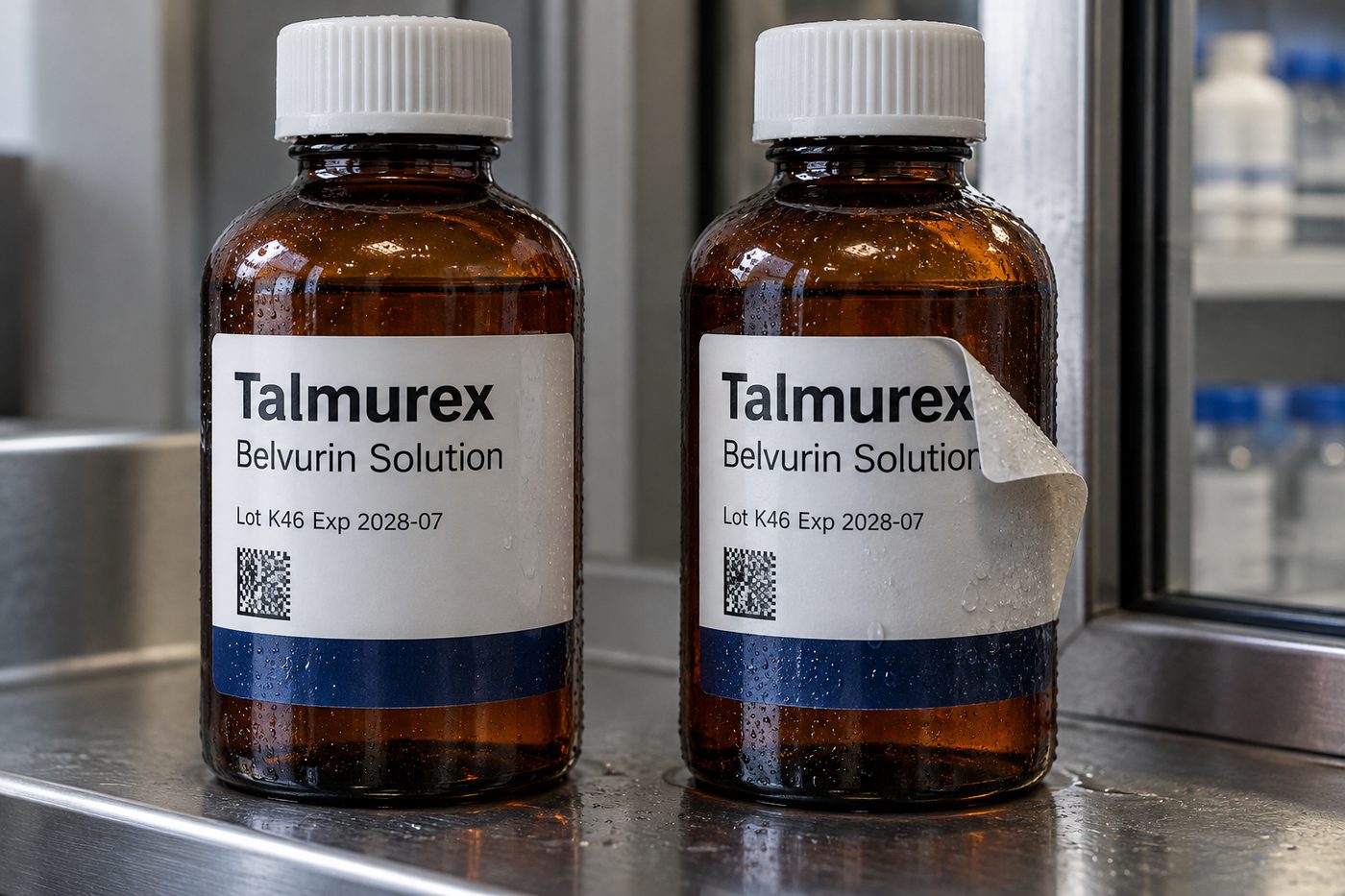
That last step matters. A label can match the proof perfectly and still fail on the product because of condensation, cold application, chemical exposure, curvature, or another condition the press never sees, which is why keeping labels on vials through freezers and wet fill lines comes down to matching materials to conditions.
Once the construction has been approved in the actual application, retain the signed proof, material specification, and approved sample as the reference for future deliveries.
Your incoming-inspection procedure determines how later shipments are sampled and accepted. If your quality system uses AQL or another statistical sampling plan, the supplier should be able to provide the lot identification and production records needed to support it.
Your reconciliation process depends on accurate information from the printer
Your procedures determine how printed labeling is issued and reconciled. The supplier supports that process by giving you reliable counts, lot identification, and documented control over overruns and obsolete labels.
During qualification, ask:
- Are quantities recorded by roll, package, or shipment?
- How is each production lot identified on cartons, rolls, or cores?
- How are overruns documented?
- How are different jobs and artwork versions segregated?
- How is obsolete or superseded printed material controlled and destroyed?
The exact reconciliation process belongs to your quality system. The printer should be able to provide the information that process depends on.
Artwork, material, and process changes should reach your change control before the press
Your quality agreement should define which supplier changes require notification or approval before production.
- Artwork changes include copy edits, barcode changes, and new versions, even ones that look minor on screen.
- Material changes cover facestock, adhesive, and ink substitutions, including materials the printer considers equivalent. These substitutions deserve particular attention because a supplier may view an “equivalent” facestock or adhesive as interchangeable while your quality system may require review or approval. Name material changes in the agreement so the equivalence decision stays with your team.
- Process changes include a different press, die, finishing method, or production site. Your procedures decide whether a change needs re-testing or re-approval, so point the notification clause at the change definition in your quality agreement and ask the printer how its own change control routes those notices to you.
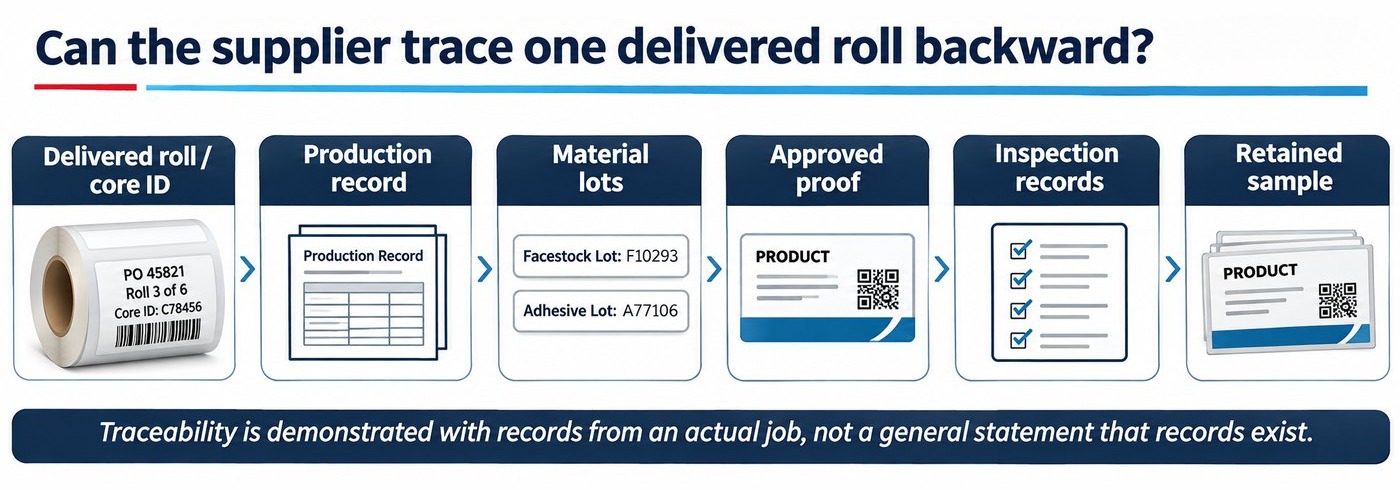
A label printer's records should trace any roll back to its proof, materials, and press run
A label printer's records let you trace a delivered roll back to its approved proof, its materials, and its press run. That record set usually includes production records by lot, approved proofs with the approver's name, incoming material verification, in-process and final inspection records, retained samples, and deviation and CAPA records. In practice, traceable means the lot number on the roll or core leads to exactly one production record.
Your procedures and the quality agreement set how long these records are kept and how often the supplier is reviewed, and periodic reviews sample these same records. During the audit, ask the printer to pull the full record for one specific roll, and note how long it takes.
What a well-prepared label printer hands your quality team
A prepared supplier should be able to support qualification with more than a completed questionnaire.
At Liberty, that can include documented production and inspection procedures, material specifications, approved proofs, production records, retained samples, lot-level traceability, change-control documentation, CAPA records where applicable, and supporting information for variable-data and serialization programs.
Our quality system is rooted in ISO 9001 principles and cGMP-style process controls. The evidence is in the procedures and records your quality team reviews.
For new applications, we can also provide samples or first-article quantities so the construction can be tested on the actual container and under the actual storage, handling, or processing conditions before full production.
Plan the qualification timeline around dependencies, then request these documents first
A label supplier qualification timeline is driven by dependencies more than dates. In order, the phases are questionnaire and document review, quality agreement drafting, the audit, first article and a pilot run, entry on your approved supplier list, and the first production order.
Qualification timelines vary by company, but the same dependencies tend to control the pace: questionnaire review, quality-agreement drafting, audit or records review, first-article approval, and any internal supplier-approval steps required by your procedures. Several of those activities can often run in parallel.
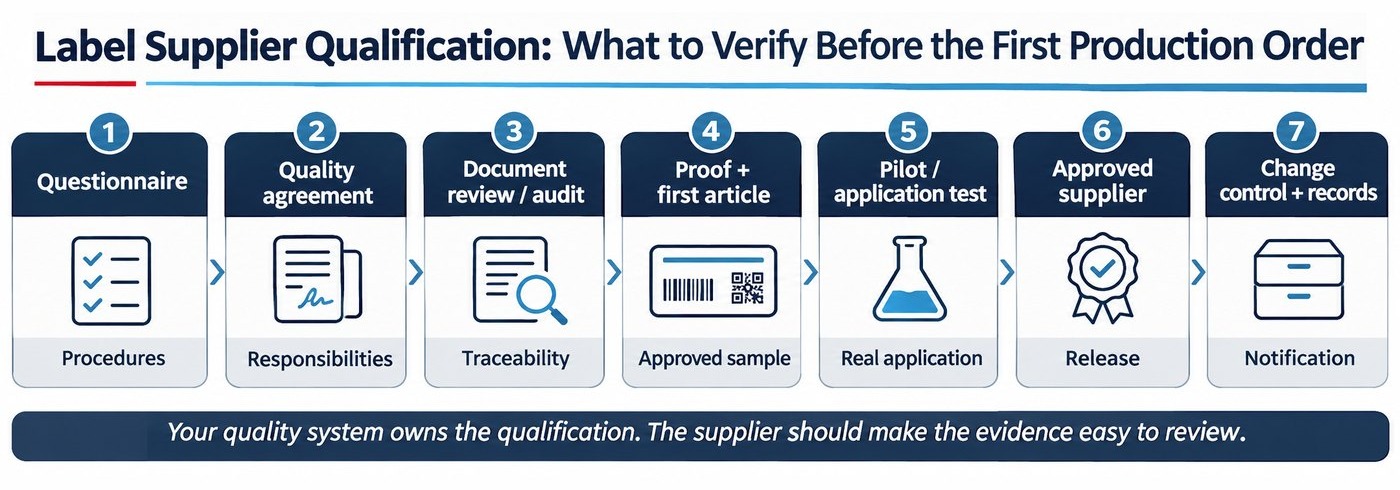
Start with the documents that create the most dependencies
Qualification timelines vary by company, but the same dependencies tend to create delays: waiting for the questionnaire, quality agreement, audit records, material information, or first-article approval.
Sending the questionnaire, draft quality agreement, and current label specification together gives the supplier a better chance to address those requirements in parallel.
Common documents requested during qualification include:
- Quality-system overview
- Completed supplier questionnaire
- Quality agreement
- Sample production or lot record
- Retained-sample policy
- Change-control procedure summary
- CAPA procedure summary
- Material specifications or datasheets
- Approved proof and first-article documentation
Your own procedures determine which documents are required before the supplier is approved.
Quick answers on cGMP, FDA, and label suppliers
Does a label supplier need to be cGMP certified?
FDA does not issue a general cGMP certificate to label printers. Your qualification should focus on whether the supplier's procedures, controls, production records, traceability, and change-management practices support the requirements your own quality system places on printed labeling.
What documents should I request from a new label supplier?
Common requests include a quality-system overview, completed supplier questionnaire, sample production record, retained-sample policy, change-control and CAPA procedure summaries, material specifications, approved proof records, and any quality agreement required by your procedures.
Should a label-supplier audit be on-site?
That depends on your risk assessment and supplier-qualification procedure. Some programs begin with a document review or remote audit, while higher-risk or more complex work may justify an on-site review. In either case, ask the supplier to demonstrate its controls using records from an actual job.
What supplier changes should require notification?
Define this in the quality agreement. Common categories include artwork, facestock, adhesive, ink or ribbon, print process, tooling, finishing method, subcontracted operations, and production site. Your quality team decides which changes require notification, review, or requalification.
How can I test a label supplier's traceability?
Select one delivered roll or lot and ask the supplier to trace it back to the approved proof, material lots, production record, inspection records, and retained sample. That demonstrates how the traceability system works on a real job.
What should I send Liberty when starting qualification?
Send your supplier questionnaire, draft quality agreement if you use one, current label specification or artwork, and any application or testing requirements. We can work through the documentation with your quality team and identify anything needed before samples or first production.
What should a supplier be able to show during an audit?
A supplier should be able to connect an actual production job to its approved proof, material specification, production record, inspection records, retained sample, and any deviation or CAPA associated with the run. The exact audit scope belongs to your quality system, but the supplier should be able to produce the supporting records without relying on general assurances.
Attach your questionnaire to the quote request
If your supplier-qualification process has already started, send the questionnaire, current specification, and draft quality agreement with the RFQ. We can address the documentation alongside the label construction rather than waiting until after the first quote.
The goal is straightforward: give your quality team enough evidence to decide whether Liberty fits your requirements.
Ready to get started? Request a quote and include your paperwork.
