Three variables decide whether digital is the right method for your run: how many labels per SKU, how many SKUs, and how often the artwork is going to change. If any two of those are pushing you toward small numbers or frequent updates, digital is probably the answer. If the artwork is locked and the quantity per SKU is deep, you should be reading the flexographic page instead.
Digital eliminates plates and setup tooling, which is why short runs and multi-SKU work land here. That's the common floor and every capability page says it. What matters more is when digital is actually the correct call, when it isn't, and what determines whether the label survives what you put it on.

Four buyer situations put a job on digital, and they all share the same underlying reason: there is no plate or die tooling worth amortizing across the run. When the tooling cost can't be spread over enough labels, it dominates the per-piece price on any plate-based method, and digital wins on the math before the press ever starts.
The four situations look like this:
Product launches where the spec, artwork, or copy is still moving and you cannot afford to be wrong once.
Seasonal, limited, or promotional runs where the label has a defined end date and volume is capped.
Multi-SKU families that share size, shape, and material but carry different flavors, sizes, or variants.
Short recurring runs where plate and die tooling would eat more than the labels themselves.
Liberty offers no minimum order quantity, competitive lead times, and regularly accommodates rush requests. The "short runs" line is technically true and practically useless on its own: the real signal is whether the artwork will change again before the labels are gone. If yes, plates you paid for become plates you throw away, and digital is the correct method regardless of quantity.
A multi-SKU family runs cleaner on digital because the press does not care that the artwork changed between the fifteenth and sixteenth label. Fifty versions of a face-stock-and-die-consistent design read as one job, provided the constants hold: same substrate, same adhesive, same laminate, same die. What's allowed to change is the art, the copy, and the color.
If flavor twelve needs a different laminate because it's an oily formulation, flavor twelve is a separate job with a separate quote, not a version in the same run. This is where a specification conversation before the quote saves you real money.
The versioning value also depends on what happens after the first run. Liberty retains job specifications and physical samples from prior runs, so the reorder doesn't start from a rebuilt file and a guess at the color. Retention isn't paperwork; it's the mechanism that keeps consistency built in when flavor thirteen shows up nine months later.
Variable data printing does one operational thing worth talking about: it removes a second labeling or coding pass from your packaging line. The lot code, expiry, barcode, or serial number that would have been slapped on downstream is instead printed into the label itself.
Two flavors matter. Per-lot variables (lot code, expiry date, batch number) change every production run but stay constant within a run. Per-unit variables (serial numbers, one-to-one personalization, unique QR codes) change on every single label.
The file build is different for each, and the pricing is different for each. Most buyers who say they need variable data actually want lot coding, which is a template job with rolling variables. If you're printing the same twelve numbers over and over, that's not VDP, and pricing it as VDP is how some shops mark up ordinary work.
Barcodes and RFID encoding conform to GS1 standards. For regulated categories where serialization or traceability is required, Liberty supplies compliant labels; the certification of the finished product remains with you.
The technical detail worth knowing is white underprint on clear or metallic substrates. On a clear amber bottle, a design printed without a white ink layer behind the color shifts brown, because the amber glass is now part of the color mix. The proof looked right on white paper, the label looks wrong on the product, and the QA team spends the afternoon trying to figure out whose fault it is.
The fix is a white ink layer laid down first, but only if the file was built to expect it and the press is set up to lay it flat. If either of those isn't true, the fix is the next run, not this one.
Reorder consistency depends on the same file discipline. When specs and physical samples from prior runs are retained, the third reorder matches the first because the shop is not re-deriving color from a printed sample that has already drifted a little. Some finishes (foil, embossing) add lead time regardless of whether the base print is digital or flexo, so if the launch calendar is tight, decide those early.
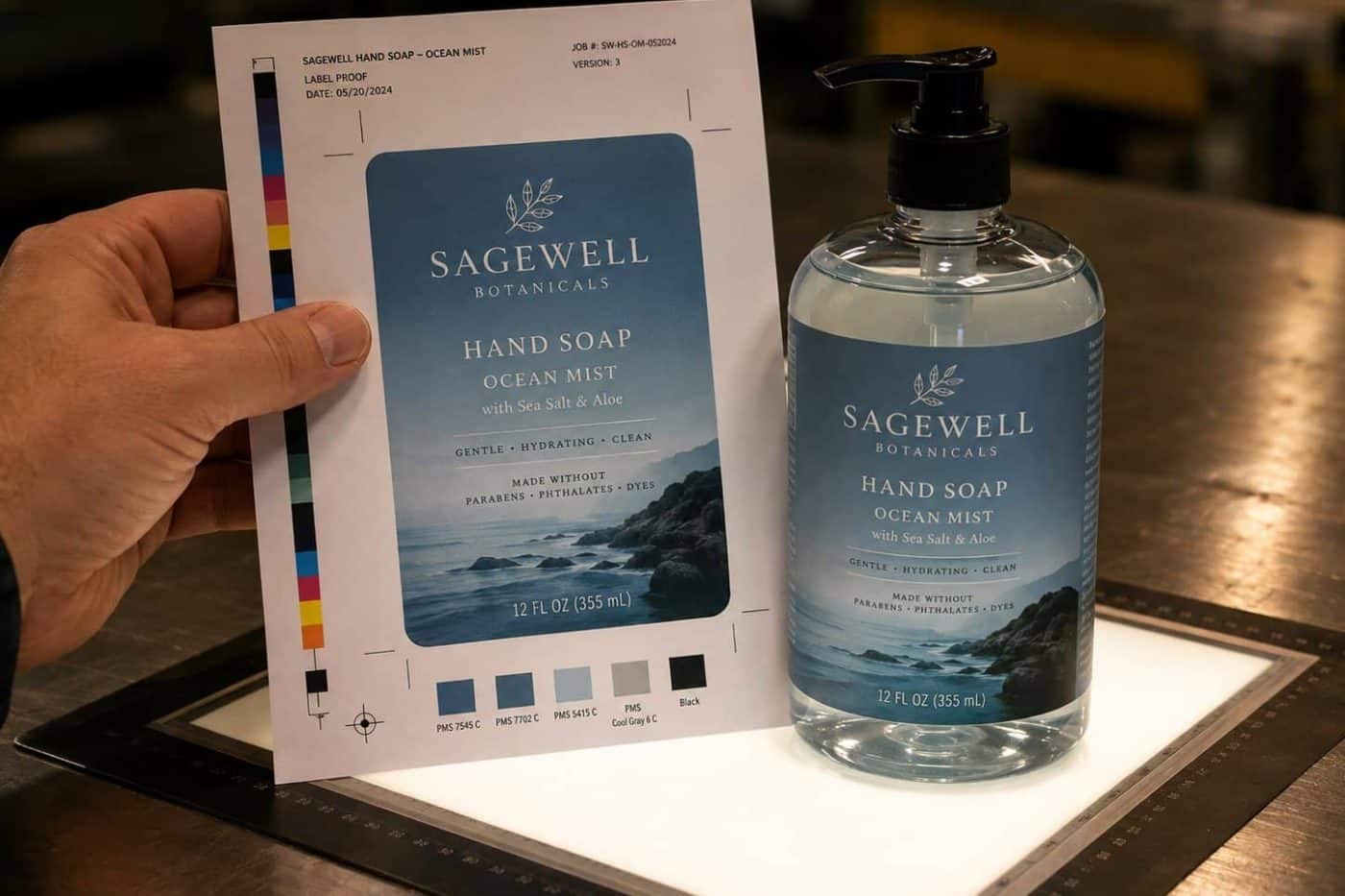
No honest shop can give you a universal digital-to-flexographic crossover unit quantity in an article. Anyone who quotes you one is quoting an average that doesn't match your job, because the crossover moves with substrate, finish, and SKU count together. What can be given honestly is the set of variables that pushes the decision, and the direction each one pushes.
The six that matter:
High quantity per SKU pushes flexographic; short pushes digital.
Many SKUs pushes digital; a single SKU with deep volume pushes flexographic.
When tooling can be spread over enough labels to disappear per-unit, flexographic wins on unit cost.
Any per-unit variable data pushes digital; per-lot codes can go either direction.
Artwork still moving pushes digital; locked artwork with a long life pushes flexographic.
Specialty foil or embossing can push either direction depending on inline capability.
Flexographic is the right answer for high-volume, artwork-stable, tooling-amortizable programs. Digital is the right answer for everything else in the mid-market. Liberty offers both and will spec whichever fits.
If you send the run length, SKU count, environment, and finish requirements, the crossover can be modeled inside the quote instead of guessed at in the abstract. When flexographic is a better fit, the capabilities page covers where that method wins.
A chemical drum sits outdoors in a yard for months, gets refilled, gets pressure-washed, gets reconditioned, and eventually ships back for reuse. The label on the side has to stay legible and intact through the product lifecycle, then come off cleanly at reconditioning without leaving adhesive residue that a solvent bath has to chase. That's not one adhesive doing one thing.
That's an adhesive spec'd against a specific surface, a specific temperature range, a specific exposure profile, and a specific end-of-life step. Get that combination right and the label does what it's supposed to. Get it wrong and it either falls off in month two or refuses to come off in month twelve.
The face stock is the first decision. Paper stocks earn shelf products where humidity and abrasion are limited. BOPP earns beverage, personal care, and anywhere moisture or light oil is a factor.
Polyester earns chemical, industrial, and heat exposure. Cold-flex film earns freezer and cryogenic, where a standard film would crack on application. None of these is universally "better"; each earns its job for a reason.
Adhesive selection is a temperature-and-surface question, not a strength question. A stronger permanent adhesive doesn't fix a cold-application problem; it just makes the eventual removal worse.
An adhesive spec'd for storage temperature instead of application temperature is the single most common root cause of what people call adhesion failure, and about eighty percent of those field failures disappear when the spec matches the surface and the application temperature. Liberty's adhesive bench covers cryogenic, permanent, removable, repositionable, all-temperature, and wash-off, which is enough range to match most industrial applications after a proper conversation.
Laminate and coating decide outdoor UV life, chemical exposure, and abrasion resistance. Digital-only shops sometimes call laminated labels waterproof; Liberty describes them as water-resistant or moisture-resistant, because "waterproof" is a claim that gets a QA team calling on Monday morning.
The MOQ conversation on most sites is aimed at someone ordering ten stickers. That's not what no minimum order quantity is really for. For a mid-market program buyer, zero MOQ is what lets you pilot a new SKU on the actual product before rolling it into distribution, run a revised artwork mid-launch without writing off a case of the old version, and test an adhesive-and-substrate combination on the real container before committing to a program run.
The MOQ question is almost never really about the MOQ. It's about whether the shop will treat a 200-piece test as a real job or as an inconvenience worth pricing out of. That's a service question, not a spec question, and the answer shows up in how the first call goes, not in the fine print.
A federal agency sent an RFQ that specified a name-brand material and called for extreme durability under temperature and weather exposure. The spec was defensible. It was also more expensive than it needed to be.
On review, the team found an alternative material that performed identically to the specified brand at 33% lower cost, went back to the product owner with the substitution, got it approved, and won the award. That contract remains Liberty's largest federal contract to date.
The money didn't come from a sharper quote on the spec as written. It came from fifteen minutes of specification review before the quote was ever built.
Independent ownership since 1969 is what makes that kind of review normal instead of exceptional. No private equity acquisition, no revolving management, no incentive to price the spec you sent and move on. The team carries more than 150 years of cumulative label industry experience, works with recognized national brands across food, industrial, and outdoor retail, and holds SBA HUBZone certification for buyers who need it.
The quality system is rooted in the principles of ISO 9001 and cGMP-style process control, with documented procedures for production, inspection, and change control, and Best of Category recognition from PIA MidAmerica's Graphex competition in 2024 and 2026. Anyone selling you the press without reviewing the spec is selling you the wrong press or the wrong material.
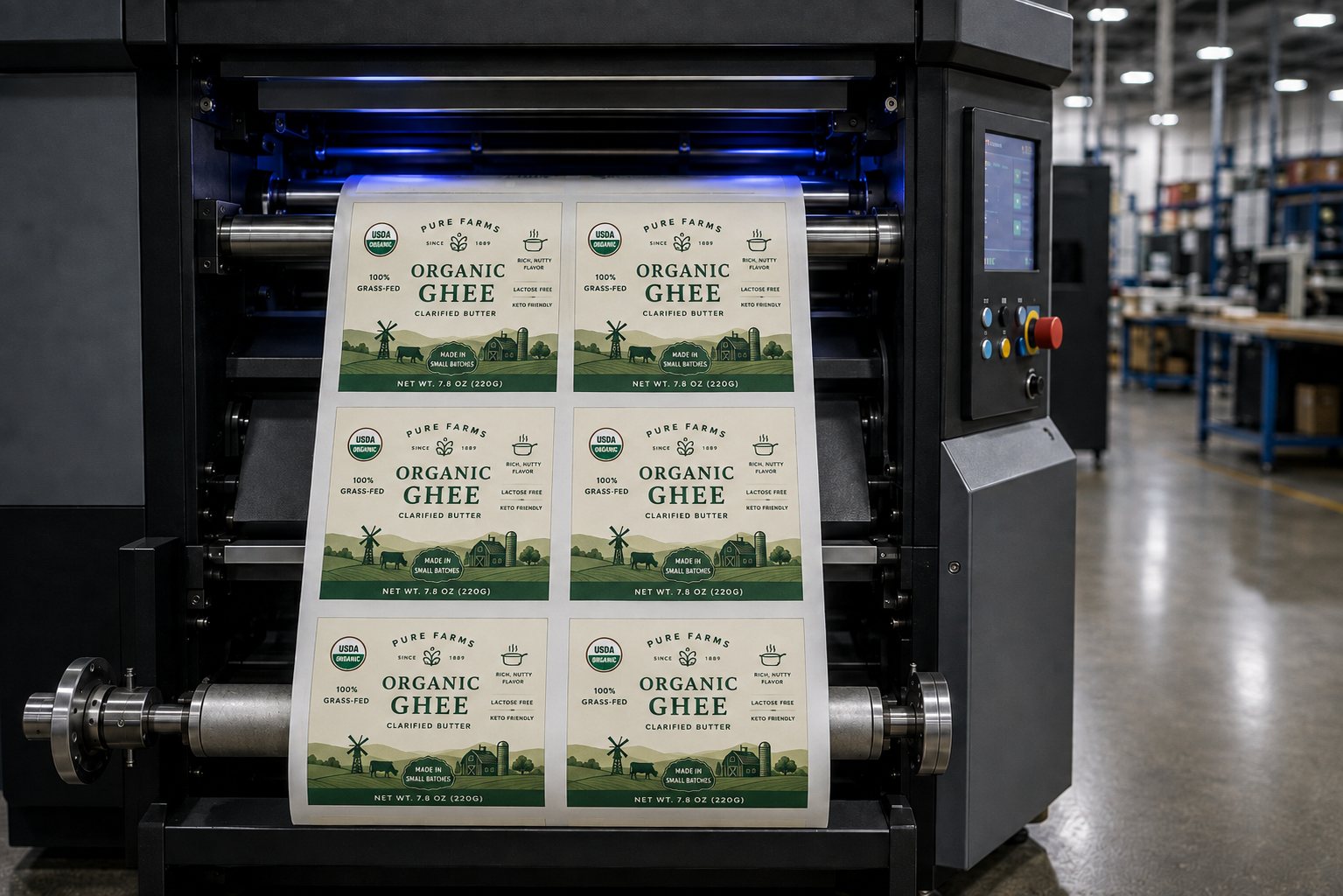
No minimum order quantity. The point is to let a program buyer pilot a SKU, run a revised artwork mid-launch, or test an adhesive on the real container without eating a case of obsolete stock. It is not built as a hook for ten-piece consumer orders.
Short runs per SKU, many SKUs in the family, variable artwork, per-unit variable data, or a run where the spec is still moving. When plate and die tooling can't be amortized over enough labels, digital wins on the math. Send the run length, SKU count, and finish requirements and the crossover can be modeled inside the quote.
Yes. Job specifications and physical samples are retained from prior runs so the reorder starts from real reference material, not a rebuilt file.
Competitive lead times, and rush requests are regularly accommodated. Liberty has delivered millions of labels inside 48 hours in emergencies that kept a customer's production line running, but that is capability under pressure, not a standard promise. The right answer for your job depends on substrate availability, artwork state, and finish.
Yes, as long as material, size, shape, adhesive, and laminate stay constant across the versions. Those are the constraints that let fifty versions read as one job on the press. If a version needs a different laminate or a different die, it becomes a separate job.
Yes. Liberty offers both methods, and the prepress work, spot color match, and file specifications carry across. When the volume per SKU justifies the tooling investment, the label looks the same on the flexographic press as it did on digital, and reorder consistency stays intact.
Yes. Physical samples for material, adhesive, and finish are part of the specification conversation before the quote. When a printed prototype matters, a short digital run is often the least expensive way to prove the label on the actual product before committing to a program run.
Send artwork or a photo, target quantities per SKU, the environment the label has to survive, and any compliance requirement. That's enough to spec substrate, adhesive, and method honestly.
Liberty ships nationally from Fort Scott, Kansas, and delivers to the United States, Canada, and Mexico. FSC® certified materials are available on request.
Ready when you are: request a quote.
Request a Quote