Liner Notes
BS 5609 Labels Explained: What the Standard Covers for Drum Labels
BS 5609 evaluates pressure-sensitive label constructions under marine and environmental test conditions, including a three-month seawater immersion test. Section 2 covers the unprinted stock and adhesive; Section 3 covers the finished printed label.
Section 3 applies to the tested combination of stock, print method, and ink or ribbon. A general claim such as "marine certified" is therefore incomplete without the section number and supporting test documentation. Whether BS 5609 applies to a specific drum depends on the shipping route and the written specification.
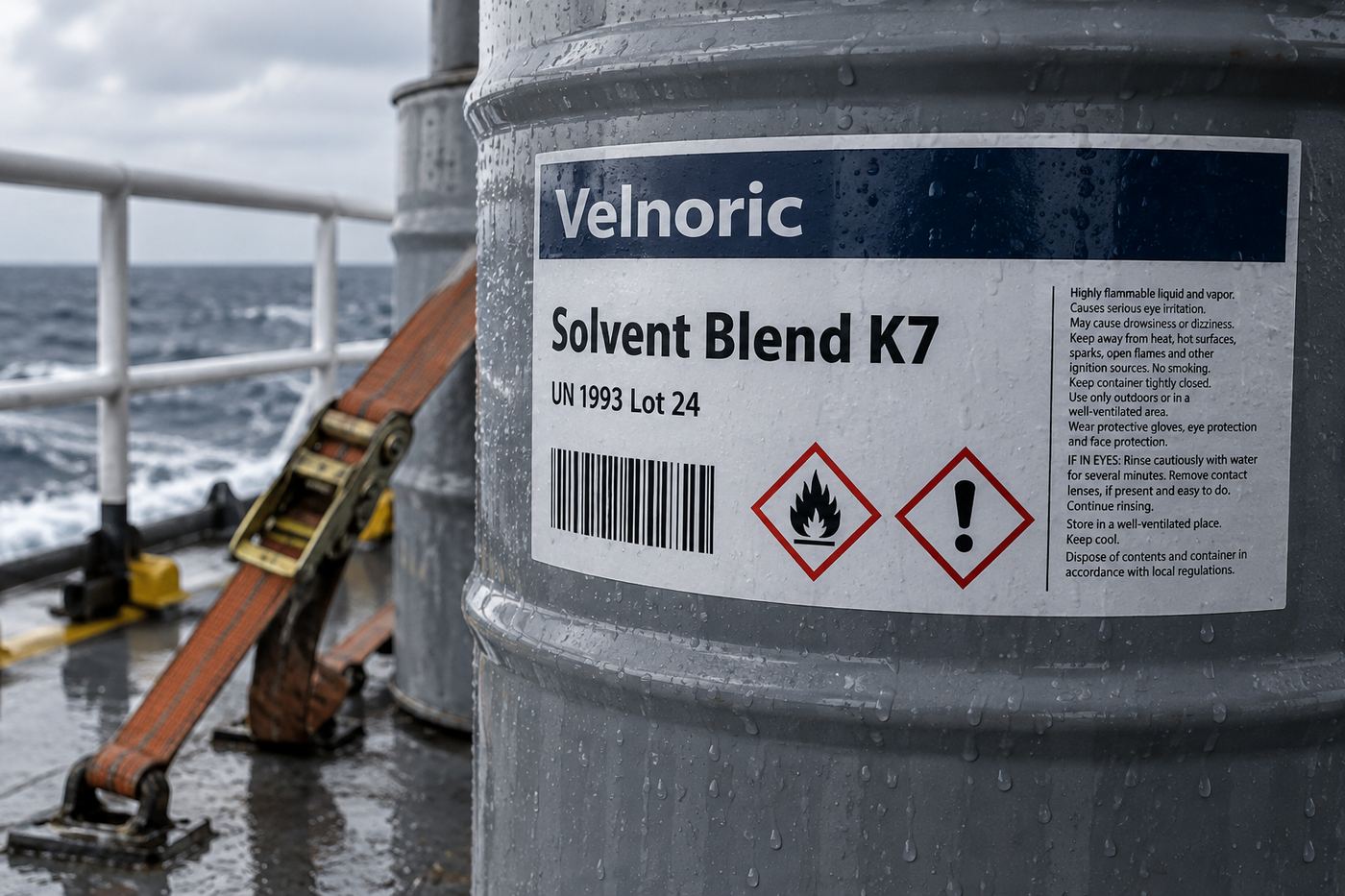
Sea transport is one of the main reasons BS 5609 appears in drum-label specifications
The IMDG Code includes a durability requirement tied to three months' immersion in the sea, and BS 5609 is commonly used as evidence of label durability for marine transport. Your transportation or regulatory team should confirm the requirement that applies to the shipment.
BS 5609 is a British Standard for pressure-sensitive labels used in marine and other severe environments. In practical terms, it provides a documented way to evaluate whether the label construction and printed image remain functional after defined environmental exposures. For buyers, Sections 2 and 3 are the parts most relevant to specifying and comparing label constructions.
BS 5609 evaluates the label construction, not the drum and not the regulatory adequacy of the hazard content. The three-month immersion period is a laboratory test condition, not a universal service-life claim for the finished package.
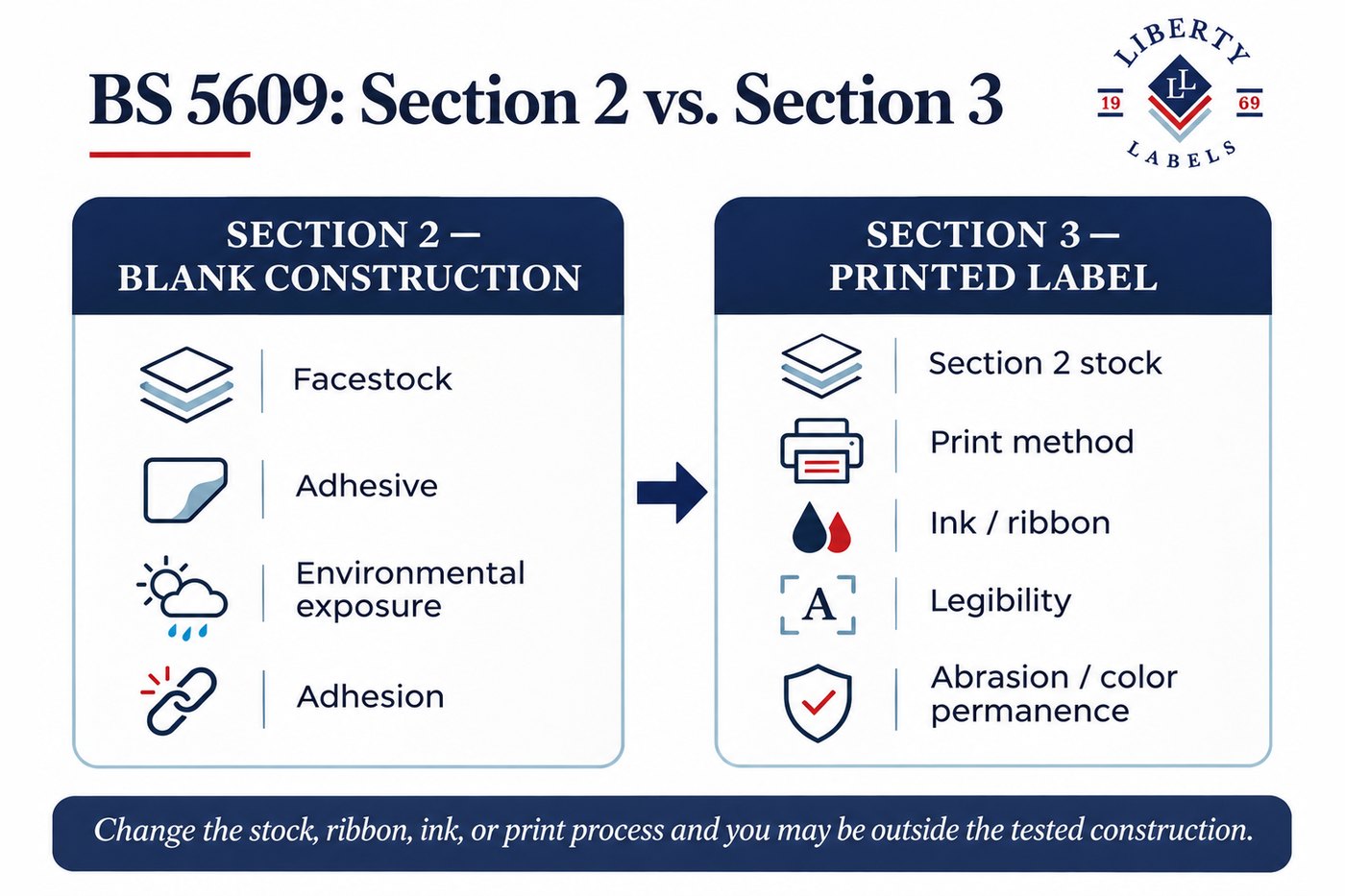
Section 2 evaluates the blank stock and adhesive before printing
Section 2 of BS 5609 tests the unprinted label material, meaning the facestock and its adhesive as one combination, applied to test surfaces and put through marine and weathering exposures.
The longest exposure is seawater immersion. Three months is how long the BS 5609 immersion test runs, and the standard sets that period as a test condition. Alongside it, the material faces salt spray plus sunlight and UV exposure, which weather the face of the film and the exposed edges of the adhesive.
Temperature cycling moves the samples through repeated changes between hot and cold, which shows how the film and adhesive hold up together. Adhesion checks then look at whether the label is still bonded to its test surface. The pass criteria live in the standard itself, and the test report records what was assessed and how the material performed.
A Section 2-rated construction establishes performance of the unprinted facestock-and-adhesive combination under the applicable tests. It does not establish how a particular ink or ribbon will perform on that stock. Many marine drum applications use permanent adhesive constructions, but the exact adhesive still has to match the drum surface and application conditions.
A Section 2-rated stock does not establish the performance of the finished printed label.
Section 3 evaluates the finished printed label
Section 3 evaluates the finished printed label as a system: stock, print method, and ink or ribbon. Changing any of those components can put the production label outside the combination covered by the test report.
Section 3 focuses on the durability of the printed result after exposure, including how well the printed image remains bonded, legible, and resistant to wear.
Legibility asks whether text and symbols can still be read. Print permanence and colorfastness check whether the image fades, washes out or shifts color.
Abrasion resistance, including sand, rubs at the surface the way grit and handling do on a deck or dock. Weathering from light and salt spray rounds out the set.
For a GHS hazard label, the practical question is whether required text, symbols, and color remain legible after the tested exposures. That is why the print method and ink or ribbon belong in the specification alongside the stock.
Ask which section, and ask to see the lab report
BS 5609 claims should be supported by test documentation for the specific construction being quoted. The report should identify the stock and, for Section 3, the relevant print method and ink or ribbon.
If any of those components change, confirm whether the new combination is still covered. Four questions usually get you to the right evidence:
- Which section does this construction meet: Section 2, Section 3, or both?
- Can you share the test report for this stock and this print method?
- Which version of the standard does the report reference?
- How do you keep the tested stock and print setup unchanged across reorders?
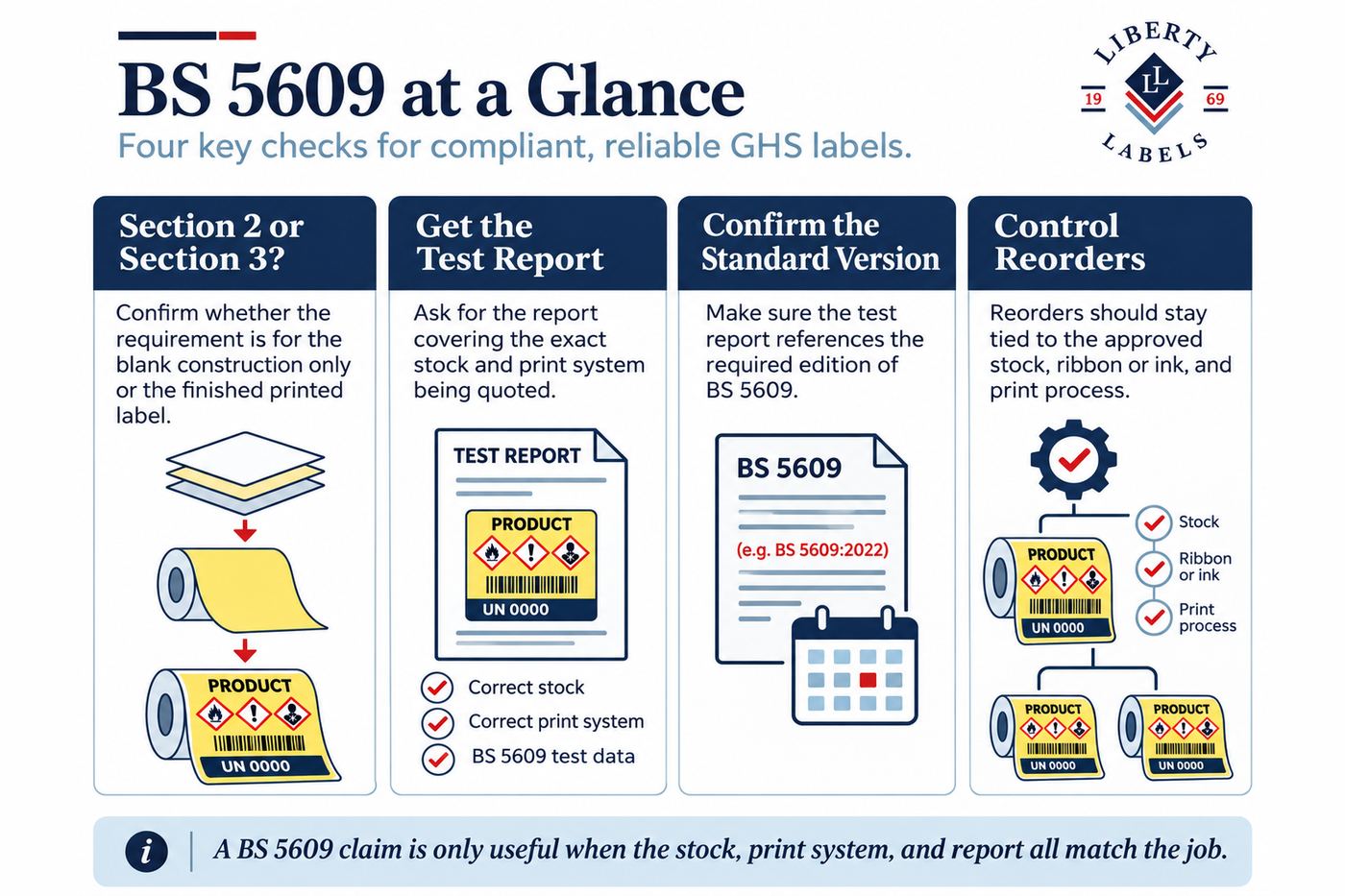
For procurement purposes, the section number and supporting report are more useful than a general "marine certified" claim. When Liberty quotes a BS 5609 construction, we identify the stock, the applicable section, and the documentation behind it.
Do all chemical drum labels need BS 5609? Often not
Not every chemical drum label needs BS 5609. The standard commonly appears in specifications for dangerous goods moving by sea, and it may also be required by a customer, carrier, or internal packaging specification. Your transportation or regulatory team should confirm whether it applies to the specific route and product.
Domestic road or rail drums with no sea leg and no stated BS 5609 requirement are often well served by a durable hazard label built to support the approved GHS content, specified around the container and the environment it lives in. If a customer, carrier or regulation names the standard, follow it. Your EHS team and counsel decide which rules apply to your shipments, and we advise on the construction that meets them.
Where BS 5609 is not required, a different durable construction may better fit applications that prioritize clean removal, relabeling, or another lifecycle requirement. A stated regulatory, carrier, or customer requirement should still govern the specification.
One example from our own work: a chemical manufacturer needed a drum label that stays on through the product lifecycle but removes cleanly when needed, and we matched the construction to that need. Clean removal is a different adhesive goal from the permanent bond a marine-route drum calls for.
The tested construction has to match the stock, adhesive, print method, and drum
BS 5609 performance belongs to a tested construction, not to one material in isolation. Film facestocks and permanent adhesives are common in these applications, but the stock, adhesive, print system, and drum surface all need to align with the documented test and the real application.
- Facestock. Polyester or polypropylene film is a common choice, often picked for moisture and abrasion resistance. Synthetic paper may also appear in some constructions.
- Adhesive. A permanent adhesive is selected for the drum surface and the conditions at application, and acrylic adhesives are common here.
- Static print. GHS pictograms, red frames and fixed statements are often flexo printed with tested inks, so the hazard content is printed once and stays consistent across the run.
- Variable print. Lot numbers and dates are often added later by thermal transfer with a resin ribbon. A thermal transfer label can meet Section 3 when that specific stock, ribbon and printer combination has been tested.
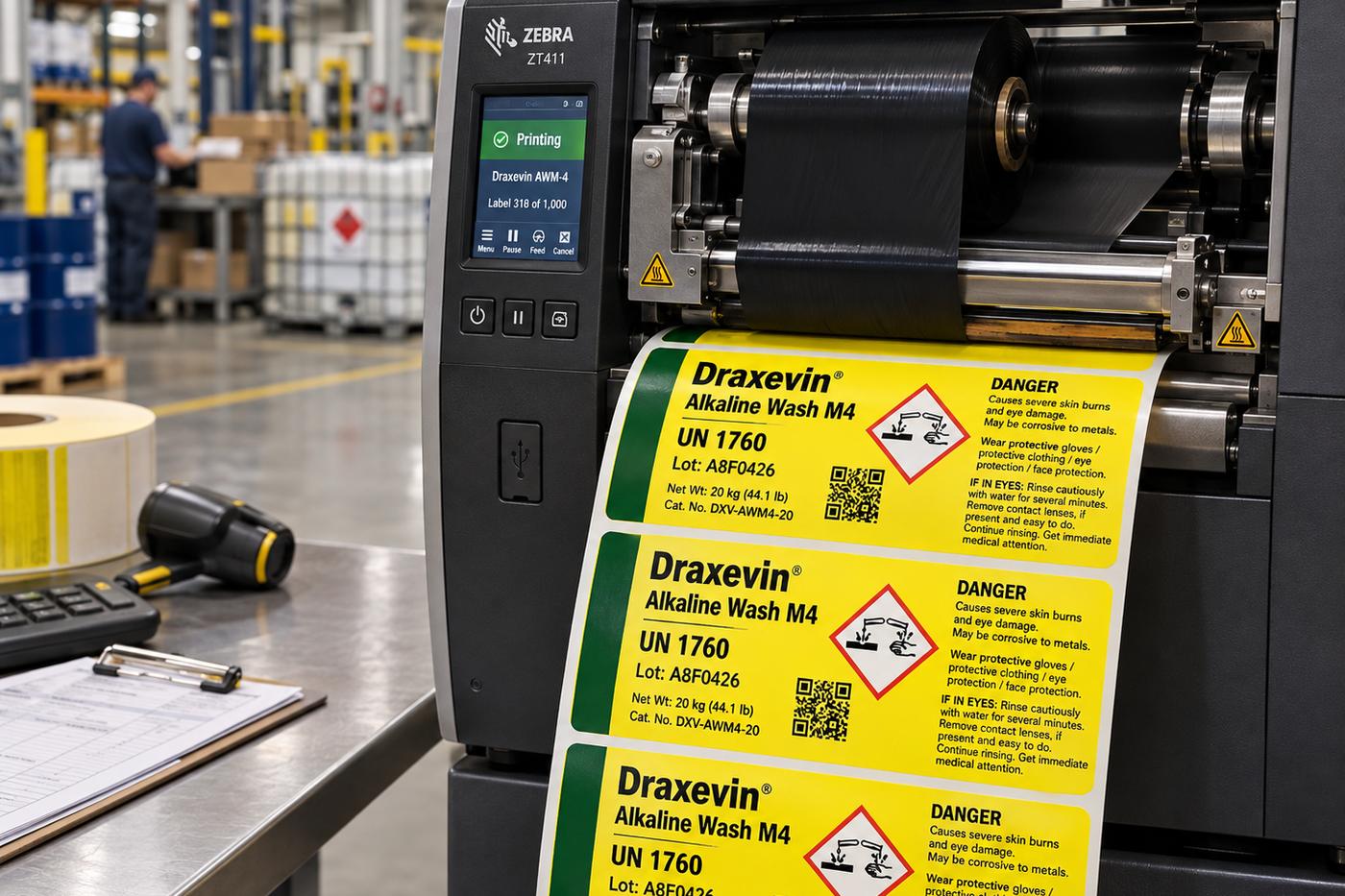
The drum surface deserves as much attention as any of those choices. HDPE is a low surface energy plastic and can be harder for an adhesive to grip than steel.
Curved, textured, cold or dirty surfaces affect adhesion too, so each gets weighed in adhesive selection and confirmed in testing. Splitting fixed hazard print from lot data only works if both processes hold up together on the same label.
Send these five details with a BS 5609 label request
Five details let a label printer specify a BS 5609 drum label construction on the first round:
- Hazard class and the GHS content your team has approved
- Container type and surface, such as steel, HDPE plastic or fiber, and open-head or tight-head if relevant
- Print method: pre-printed, printed on demand, or both
- Variable data, such as lot, date, serialization or barcode
- Whether the specification says Section 2, Section 3 or both, plus the version if stated
The container surface and the print method shape the construction more than anything else on that list, so they're the two we ask about first.
Where BS 5609 fits among GHS and transport labels
What is the difference between BS 5609 Section 2 and Section 3?
Section 2 evaluates the unprinted label construction, including the facestock and adhesive. Section 3 evaluates the finished printed label using a specific print method and ink or ribbon. A Section 2-rated stock does not automatically mean every printed version of that stock meets Section 3.
Does every chemical drum need a BS 5609 label?
No. BS 5609 commonly enters the specification when the shipment moves by sea or when a customer, carrier, or written requirement calls for it. Your EHS, regulatory, or transportation team should determine whether the standard applies to a specific shipment.
Can I change the ribbon or ink on a Section 3 construction?
Not without checking the test documentation. Section 3 applies to the tested combination of stock, print method, and ink or ribbon. A change in one of those components may put the finished label outside the tested construction.
What should I ask a supplier claiming a label is “marine certified”?
Ask which section of BS 5609 applies, which version of the standard was tested, and for the test report covering the exact stock and print system being quoted. Those details are more meaningful than the phrase “marine certified” by itself.
Does GHS require BS 5609 labels?
No, GHS doesn't call for BS 5609 labels. The UN Globally Harmonized System sets hazard content and format. The marine durability requirement comes through the IMDG Code for sea transport, and customers or carriers may add it to their own specifications.
What should I send a supplier with a BS 5609 quote request?
Send the approved hazard content, drum material and surface, application conditions, print method, variable-data requirements, and the applicable BS 5609 section or customer specification. If a specific tested construction or report is required, include that reference as well.
Does BS 5609 test the drum itself?
No. BS 5609 evaluates the pressure-sensitive label construction and, in Section 3, the printed image. Drum material and surface still matter because they affect adhesion in the real application, but the standard does not certify the drum or determine the regulatory content printed on the label.
What is the difference between GHS labels and transport labels?
GHS labels communicate a chemical's hazards, while transport labels communicate its dangerous goods class to handlers along the route. Transport rules, such as the IMDG Code at sea and US Department of Transportation hazardous materials regulations on the road, set class labels and marks across nine classes of dangerous goods. The route also sets how durable the label must be. Both commonly appear on one drum.
When a spec sheet says "marine certified," verify the construction behind the claim
First confirm whether BS 5609 is actually required for the shipment or specification. Then identify the section and standard version, and review the test report for the exact stock and print system being quoted. If BS 5609 is not required, specify durability around the container, exposure, and handling conditions instead.
Send the approved content, drum details, print requirements, and BS 5609 specification through our Request a Quote page, and we'll help identify a documented construction worth evaluating on the actual container.
