A chemical drum sitting outdoors through a Midwestern summer. A freezer case where the label has to still be scannable at negative twenty. A brand PMS that has to match reorder to reorder while your procurement lead rotates and your co-packer changes wash chemistry. These are the labels people call about, and they are the ones flexographic printing was built to run.
Flexo is the right press when you have real annual volume, a spot-color brand demand, or a label that has to survive a specific environment. That much most converters will tell you. What they rarely tell you is that the first run is not where a flexo partner is judged. The reorder is.

Two conditions decide flexo. The first is recurring annual volume on a defined SKU, high enough that the plates and makeready pay for themselves against a lower per-label price at scale. The second is a finish flexo runs better than digital: an opaque white behind a graphic on clear film, hot or cold foil, embossing, a spot varnish, a tight PMS match on a hero brand color.
Flexography itself is a rotary printing process using flexible photopolymer plates and fast-drying inks, with print, coating, die-cut, and finishing typically running in one pass through the press. That is roughly all you need to know about the mechanism to make a good decision.
If your job has one of those two conditions, flexo is likely the right press. If it has both, it almost certainly is.
The number that decides flexo is not a color count. It is annual volume on this SKU, and whether the artwork carries a finish digital cannot hit. If you have neither, you are probably a digital job, and a converter who tells you otherwise is defending equipment rather than serving your label.
Before we quote a job, we ask two questions. Where does the label live, and what does it have to survive. The answers to those two questions decide the facestock, the adhesive, the coating, the ink system, and often the press.
Everything else on our capability list is a shelf of options waiting to be matched to the answer. A capable flexo shop specs from the container and the environment out. A less capable one hands you a menu and hopes you know which item you want.
The label problem on a chemical container is not survival. It is clean removal at end of life. We ran a program where the drum label had to hold through the full product lifecycle, then release cleanly when the drum came back for refurbishment. A permanent acrylic would have survived and become a legacy label on a returnable container. A removable would have flagged inside a month in a hot warehouse. The right answer was an adhesive matched to the wash chemistry and the storage temperature, on a facestock that held up to solvent splash. Bring the container, the fill, the storage environment, and any GHS, DOT, or BS 5609 requirements to the first conversation, and we build the spec around them.
Cold breaks labels in three ways. The facestock gets brittle. The adhesive fails to grab a cold, condensating surface. The barcode washes out under frost. Cold-flex films, freezer-grade adhesives, and cryogenic adhesives for anything going into liquid nitrogen each solve a different piece of that problem. What matters when specifying is the application temperature, the service temperature, and the surface condition at the moment of application. A cryogenic adhesive that works on a vial at minus 196 will not necessarily hold on a freezer case that is applied at room temperature and then chilled.
UV coating and overlaminate are the difference between a label that fades in a season and one that stays legible through sun, rain, and washdown. On outdoor equipment, agricultural containers, or building material tags, the facestock is usually polyester or polypropylene, chosen for dimensional stability and UV resistance rather than print appearance. Adhesion to curved and textured surfaces is where a lot of outdoor labels fail. If the label is going on a powder-coated tank or a rough polymer housing, we test the adhesion before we print the run, not after.
On a prime label, everything else is table stakes and color is the job. Shelf presence, brand-color fidelity across production lots, and compliance labeling running quietly in the background. We have run prime work for national consumer brands, and the technical work looks less like a press capability discussion and more like a color management conversation. What is the PMS target, what proofing method is authoritative, and how do we hold that target across runs one, three, and eleven.
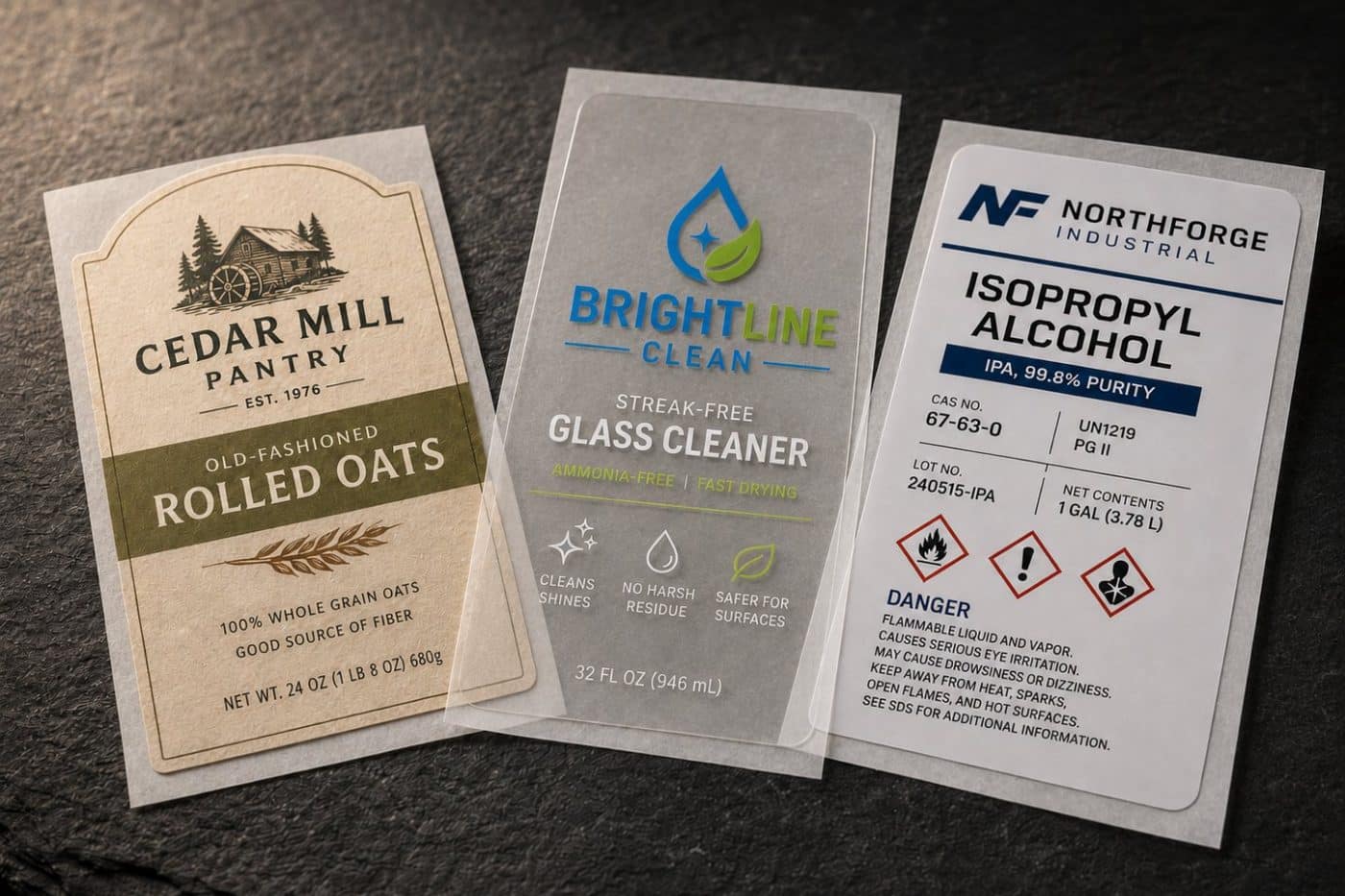
We offer four-color CMYK process with up to four spot colors, which is enough for a brand palette plus a spot varnish and a metallic hit on the same job. That is a capability, not the story. The story is what breaks color between runs, because color drift almost never happens on the first order.
It happens on reorder three, when the plates have worn slightly, or on reorder five, when a different ink lot is on the shelf, or on reorder seven, when the pressroom press notes from your original job were never written down and the operator who ran it has moved on. A shop that treats each reorder as a fresh job will drift. A shop that treats reorders as continuations will not.
What Liberty does about it is boring and systematic. We retain job specifications and physical samples from every prior run, and we inspect against those samples on every reorder. Our quality system is rooted in the principles of ISO 9001 and cGMP-style process control, with documented in-process inspections for print accuracy, color match, adhesion, and die-cut accuracy, plus lot-level traceability that lets us reproduce any run from its records.
When you call for a reorder, we are not looking at a fresh PDF. We are looking at what left the building last time.
Our flexo output has earned Best of Category recognition at the PIA MidAmerica Graphex awards in both 2024 and 2026, judged on the finished label rather than on the equipment that produced it.
Flexo earns the job when the artwork is not just ink. Combination inline finishing is why a specialty label can come off one pass rather than move between vendors, which is where color drift, handling damage, and lead-time creep tend to enter a job. On a single pass we can handle:
UV coating and overlaminate, so a label survives handling, moisture, and years of shelf life.
Hot foil, cold foil, and embossing, for shelf presence on prime brands.
Specialty varnishes for tactile finishes that a consumer actually feels on shelf.
Die-cutting to any shape the artwork calls for, including intricate custom shapes.
Delivery in rolls, sheets, or continuous fanfold, matched to your application equipment.
Not every job belongs on flexo. Variable data and serialization belong on digital.
So do short runs, program pilots and market tests, frequent artwork changes, small-batch or seasonal SKUs, and any launch where the annual volume has not been proven yet. Digital sets up fast, prints economically at short lengths, and handles variable content that would require plate changes on a flexo press.
| Flexo | Digital | |
|---|---|---|
| Annual volume | Hundreds of thousands of labels and up on a stable SKU | Launches where annual volume is not proven yet |
| Typical jobs | Recurring runs where plates and makeready pay for themselves | Short runs, program pilots and market tests, frequent artwork changes, and small-batch or seasonal SKUs |
| Finishes | Opaque white on clear film, hot or cold foil, embossing, spot varnish, and tight PMS matches | Short runs that need one of those finishes still go to flexo |
| Variable data | Variable content requires plate changes | Handles variable data and serialization |
| Setup | Makeready and plate costs are real | Sets up fast and prints economically at short lengths |
Flexo makeready and plate costs are real. On a short run, those costs are spread across too few labels, and the per-label price loses to digital. We offer both flexo and digital at Liberty, which means our recommendation follows your job rather than our equipment.
A shop that only offers flexo will find a flexo answer for every request. That is not a service posture we are willing to offer. If your job is a digital job, we will tell you, and we will run it that way.
A customer called on a Tuesday afternoon. Their existing supplier had missed a delivery, their production line was scheduled to run Thursday morning, and they needed millions of labels on the dock in Fort Scott before the shift started. Because we had their spec on file, physical samples from the last run in retention, and material already stocked, we ran the job overnight and delivered it.
The labels were on their line the next morning, and the line ran on schedule. That is not a standard turnaround. It is what happens when everything upstream is already in place.
Retention among our active accounts approaches one hundred percent, and the reason is not loyalty. It is that reorders arrive already spec'd. Job specifications and physical samples from prior runs are retained, the quality system produces documented production records and in-process inspections that make each run reproducible, and structured corrective and preventive action handles the rare miss.
Independently owned since 1969, with more than one hundred fifty years of cumulative team experience on the floor, we have not been through the acquisition and restaffing cycles that larger converters and PE-backed roll-ups have. The person who specs your first job is still here on your fifth.
Our lead times are competitive, and we regularly accommodate rush requests. The point is not the speed. The point is that speed is the visible payoff of a system that already knew your job.
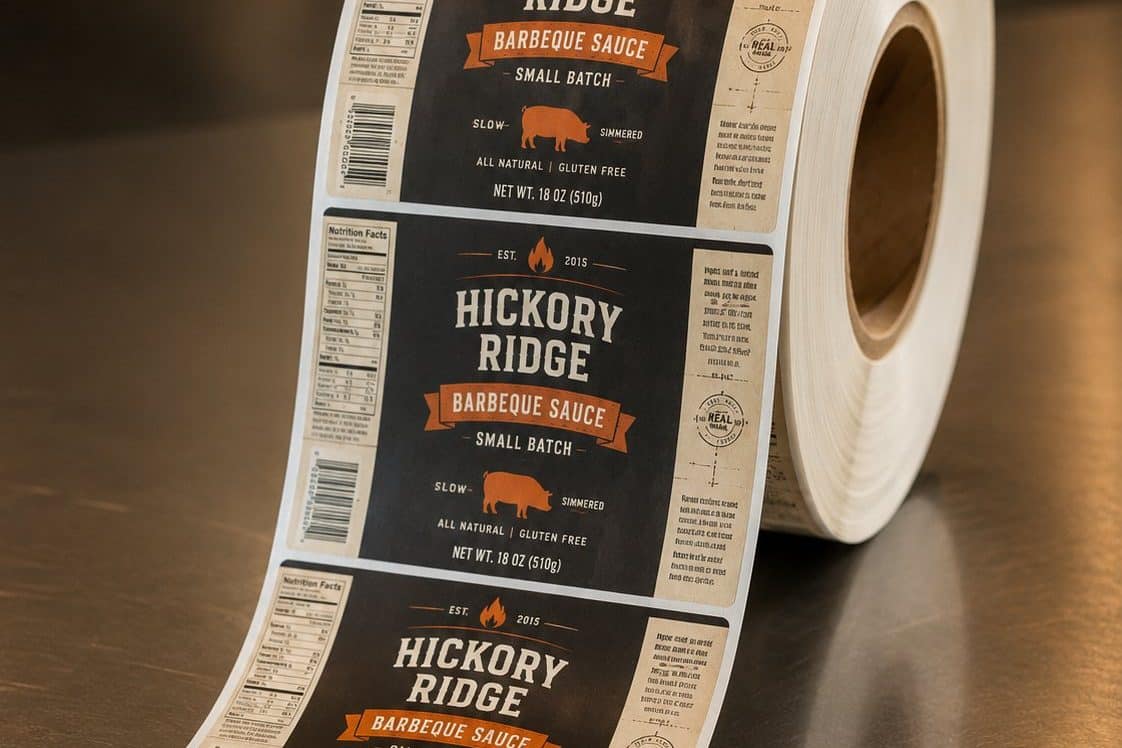
Flexography is a rotary printing process that uses flexible photopolymer plates and fast-drying inks. Print, coating, die-cutting, and finishing typically run in one pass through the press. It is well suited to long recurring runs and to jobs with spot colors, foil, or specialty finishes.
Two questions decide it honestly. How many labels per year on this single SKU, and does the artwork include spot brand colors, foil, embossing, or opaque white. Recurring annual volume in the hundreds of thousands and up on a stable SKU is the usual flexo threshold. Shorter runs still go to flexo when a finish digital cannot hit is required.
Up to four spot colors alongside four-color CMYK process, which is enough for a full brand palette plus a spot varnish and a metallic hit on the same label. PMS matching runs through a documented color-match workflow, with physical samples retained between runs so the target on reorder five is the same target as run one.
Yes. Job specifications and physical samples from every prior run are retained, and each reorder is inspected against those samples for color match, print accuracy, and die-cut accuracy. Our quality system is rooted in the principles of ISO 9001 and cGMP-style process control, with lot-level traceability. The failure modes reorders usually hit, ink lot variance, plate wear, and undocumented press notes, are the things that system is designed to catch.
Yes, and this is how many customers scale. A launch runs on digital while volume is unproven. Once annual volume justifies plates and makeready, the same artwork moves to flexo, with plate separations and spot color builds handled in prepress. The brand color target and the retained sample remain the reference, so the label the consumer picks up looks like the one they picked up before.
Yes. We provide a digital proof for content and layout on every job. For color-critical or brand-critical work, we can provide a hard proof on the actual production material before the run.
The largest US label converters are publicly traded and private-equity-backed groups running dozens of locations across the country. The size that matters for your job is the team specifying and running it, not the corporate footprint. On a specific label, a stable team with your spec on file will outperform a larger shop that treats your account as one of thousands.
A new narrow-web flexographic press is a seven-figure capital investment. If you are evaluating converters, what matters is what the press produces on your job, not what it cost to buy.
If that describes your situation, the first conversation is short and specific. We ask about the container and the fill, the environment the label has to survive, the storage temperature or outdoor exposure, the annual volume on the SKU, and any compliance frame the label sits inside. We provide a digital proof for content and layout, and a hard proof on the actual material for color-critical work.
There is no minimum order quantity, and where an alternative material would perform identically at lower cost, we say so. When you are ready, request a quote and bring the container, the environment, the annual volume, and the artwork or a current label.
Request a Quote