Two things have to be true on a pet product label: the guaranteed-analysis panel is still legible when the bag hits the shelf, and the label is still on the bag.
Everything else follows from those two facts. The brand owns the words on the panel, the review by regulatory counsel, and the final sign-off on what claims can appear where. We spec the substrate, adhesive, and finish so that panel stays readable on that container through freezer cycles, oil migration, curved-surface stress, and the year a bottle of shampoo spends in a wet bathroom. We work with pet food, treat, supplement, grooming, and animal health teams on both problems by container type, because in production they are the same problem.

Pet food and treat panels follow a familiar order: product name and species, ingredients in descending weight, guaranteed analysis with minimums for crude protein and fat and maximums for fiber and moisture, a nutritional adequacy statement, feeding directions, net quantity, and the manufacturer name and address. The framework behind that layout comes from AAFCO's model regulations, which state feed control officials adopt and enforce; FDA's pet food industry guidance sits alongside it, and EPA pesticide labeling rules apply when a product carries a repellent, flea, or tick claim.
Our job is different from your regulatory counsel's. We produce to that layout. We spec the substrate and print process so 6-point body copy with a 0.3 mm stroke stays legible under an overlaminate.
We flag when a proof puts the required content at a size or contrast that will not survive the finish you asked for. What we will not do is tell you your ingredient statement is compliant. That call belongs with your regulatory team, and our content rules are firm on it: we support your compliance work, we do not certify your product.
A kraft treat bag comes off the line clean. Three weeks later, a translucent halo shows up around the printed area, the guaranteed-analysis panel is going soft, and the ink on the ingredient list has started to smear at the corners.
That is not a print problem. That is oil migrating through an uncoated paper facestock.
Fats and oils in dog and cat treats wick into paper labels from the pouch side and from the treat side. On a paper facestock without a barrier, the oil reaches the print layer within days and the coating within weeks. Ink lifts.
Print smears when the bag is handled. The panel that carries the required content turns translucent and stops reading. The fix is a film facestock, BOPP or polyester, with the print protected by an overlaminate or UV coating that also acts as an oil barrier.
If your current supplier quoted a white paper facestock for a treat bag with meaningful oil content, you will see bleed inside a quarter. That is a specification problem, and it is the single most common reason a pet brand comes to us asking to switch.
Flexible pouches bring a second problem: metallized foil laminates and some poly pouch films are low-surface-energy substrates that fight adhesion. The adhesive family matters as much as the facestock; a standard permanent acrylic on a metallized pouch releases at the edges within weeks.
Flood-coat backgrounds, which are common on treat and food bags, drive the press decision. Flexographic wet-on-wet handles heavy solid coverage across long runs; a digital press with high-opacity white behind the flood earns its keep on short runs and version merging.
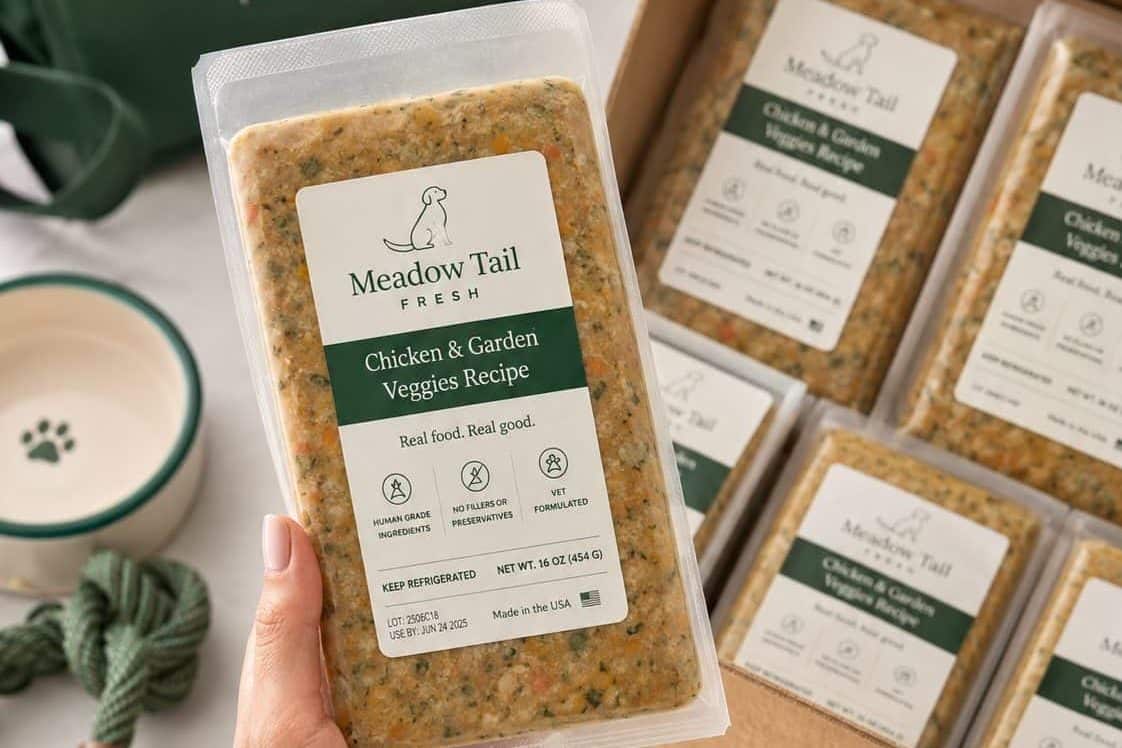
Two temperatures matter on a frozen or raw pet product label, and they are not the same. Application temperature is the temperature of the container and the room at the moment the label is applied.
Service temperature is where the product lives from filling through shelf life. A standard permanent acrylic applied to a bag that goes into a -18°C freezer within an hour never fully wets out; the adhesive edge-lifts within days because it never had the room-temperature dwell it needed to bond.
The solution is either a freezer-grade adhesive rated for cold application or an all-temperature adhesive with a wide service window. For raw frozen product packaging and biologics-adjacent lines, cryogenic adhesives extend the range further. Facestock matters too, because paper embrittles and cracks under freeze-thaw cycling while cold-flex polypropylene and polyester formulations stay pliable.
Our adhesive range covers cryogenic, permanent, removable, repositionable, all-temperature, and wash-off, which is the breadth this category needs. Nine times out of ten, when a raw or frozen pet-food brand tells us their labels keep coming off in the freezer, the failure is not the freezer.
It is a warm-room adhesive applied to a container that went straight into the cold chain. Ask what temperature your line applies at, then spec backward from that number.
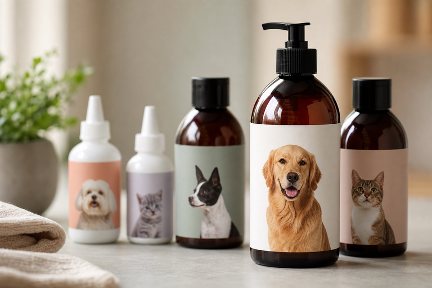
An HDPE shampoo bottle or an LDPE squeeze topical is where cheap labels lose accounts. Both are low-surface-energy plastics, and standard permanent adhesives release at the edges within weeks. On these containers, specify the adhesive family before the facestock: a low-surface-energy adhesive chemistry that is engineered to wet out on polyolefins, paired with a BOPP or polyester facestock, with an overlaminate over the ingredient and dosing panel to protect the print from repeated handling with wet hands.
PET supplement jars and tubs bring the curve-conformance problem. A label that looks flat on a proof will edge-lift on a tight radius unless the adhesive is rated for the diameter and the facestock is thin enough to conform.
The panel that gets read at point of sale, usually the back panel carrying the guaranteed analysis and directions, wants an overlaminate for print protection and legibility. Spot color matching keeps the brand red on that jar consistent from your first run to your fifteenth reorder.
Animal health bottles and vials add chemistry and small-format legibility at the same time. Essential oils, alcohol carriers, and hydrogen peroxide in some topicals will interact with the wrong adhesive or lift the print without a laminate. Vet-channel and dispensing products may need tamper-evident films.
When the container is two ounces and the dosing regimen needs a full paragraph, extended-content and booklet labels give you the panel area without shrinking the type past what a customer can read. If you sell supplements alongside food and topical lines, our supplement and nutraceutical work covers the dosing-panel detail more deeply.
Lot codes, expiration dates, and print-run identifiers on the label itself, not stamped downstream, give you a traceable record when something needs to be traced. Variable data at run time on a digital press makes this straightforward.
Lot codes and expiration dates printed as variable data during the run, not applied downstream
GS1-conforming barcodes verified for readability on the substrate
Sequential numbering for internal batch tracking and inventory reconciliation
QR codes for consumer-facing recall communication or dosing information
Retained job records that tie a specific label to a specific print run and material lot
The moment traceability matters most, a recall, is a bad time to discover your labels were not marked with the print-run identifier. Tying the label back to the material lot and the press run lets a recall trace to a specific production window rather than to the last six months of inventory.
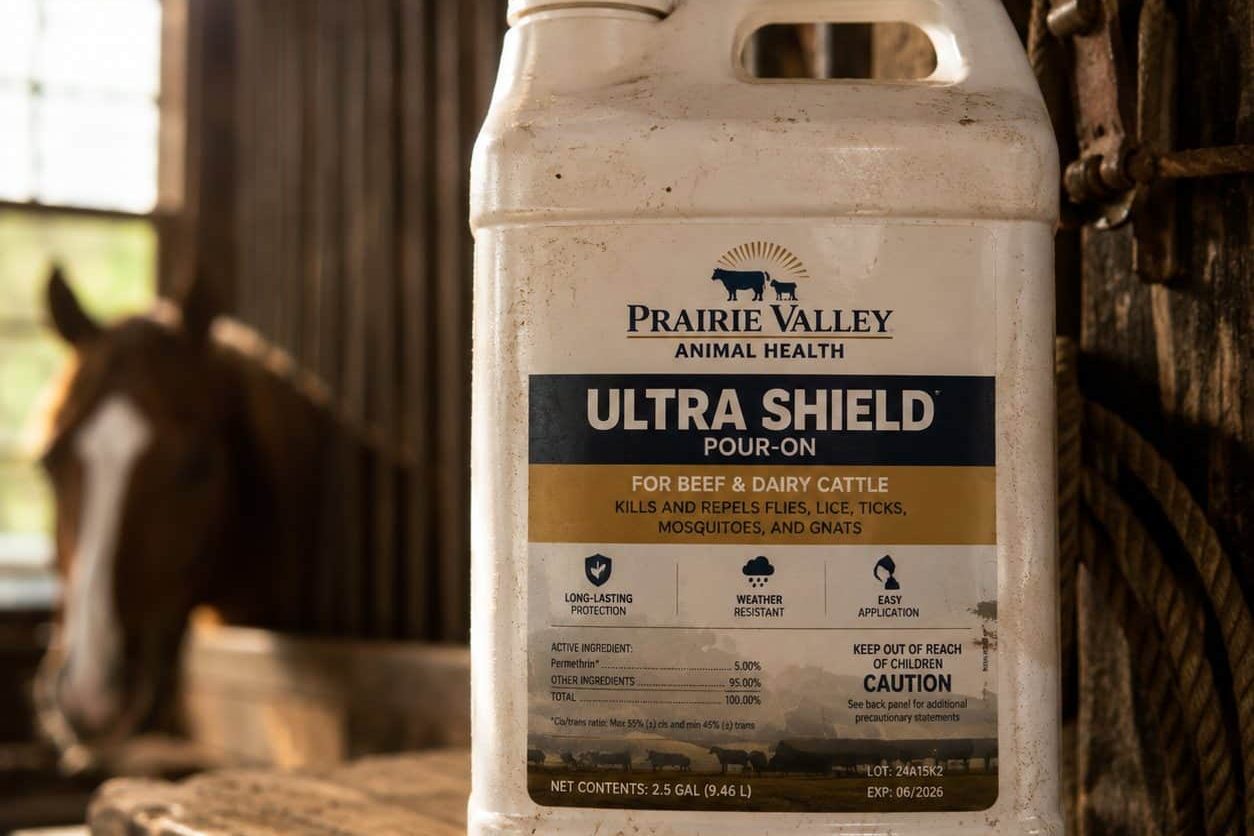
Nothing pressure-sensitive is waterproof in the way a buyer hears the word. We will call a label moisture-resistant, tell you the exposure it is rated for, and spec the overlaminate that gets you the last mile. That is the honest word for what a well-specified label actually does outdoors.
For equine insect repellents, livestock supplements, feed bags, and pet products stored in a barn or a garden center, three things drive the spec. UV coating and UV-stable inks under a laminate keep print from fading through a summer of direct sun. Freeze-thaw cycling matters as much as it does on frozen food, because a barn in January and a barn in July both happen every year.
Chemical resistance against repellents, disinfectants, and the residues in an animal-care setting keeps the panel legible when a hand carrying product residue drags across the label. On feed bags and bulk containers, abrasion during palletizing and handling is the failure mode people forget until they see labels arriving at retail with the print worn off the high spots.
The week a customer's production line was about to go down for lack of labels, we delivered millions of units inside 48 hours. That is not our lead time.
That is what we can do when someone's operation is on the line. Our lead times are competitive, we regularly accommodate rush requests, and once your specs are on our shelf, reorders start where the last run ended.
Every job starts with an application diagnostic before the quote: what the container is, what is inside it, where it lives from filling to shelf, and what the panel has to keep saying six months in. There is no minimum order quantity, which matters when a formula changes quarterly and a 500-unit test run of a new flavor should not require justification. We retain job specifications and physical samples from prior runs, so a reorder does not start from re-uploading files.
FSC®-certified materials are available on request. We offer both flexographic and digital printing, with up to four spot colors and hard-proof color matching for color-critical work.
Our quality system is rooted in the principles of ISO 9001 and cGMP-style process control: documented procedures, supplier qualification, in-process inspection, and lot-level traceability. Liberty Labels has been independently owned since 1969, with more than 150 years of cumulative label industry experience across the team. No private equity firm, no rotating corporate parent, no revolving management.
When you call, you reach a person who knows your account. If you want the operational detail, our capabilities page covers the presses and finishing.
Yes. Film facestocks such as BOPP or polyester, paired with an overlaminate or UV coating, stop the oil migration that would turn a paper label translucent. The right pick depends on the fat content in the food or treat and the pouch material underneath, which is why we ask about both before quoting.
Yes, when the adhesive is matched to application temperature rather than just service temperature. A freezer-grade or all-temperature adhesive on a cold-flex facestock holds through the cold chain. The number that usually decides whether a label stays on is the temperature of the container and room at the moment the label is applied.
Yes, including foil-lined, metallized, and low-surface-energy poly pouches. The adhesive family drives it. Some pouch surfaces need a specific chemistry to hold, and facestock and print process follow from that choice rather than the other way around.
Yes. Variable data on a digital press, GS1-conforming barcodes, and retained production records tie a specific label back to a specific print run and material lot. Recall readiness starts with how the run was documented and verified, not just with what appears on the label.
No minimum order quantity. A short test run of a new flavor or reformulation does not need justification. The digital process makes low quantities and version merging economic, which fits the reality of a growing brand with SKUs still moving.
Yes. Four-color CMYK process printing with up to four spot colors, plus spot color matching and color consistency across reorders. Send us a current label and we can recreate the artwork, and we can produce a hard proof for physical color matching on color-critical work before the press run begins.
Three moments bring pet and animal health brands to us. The growing brand reformulating every quarter, whose SKU count has outpaced a supplier that only quotes in ten-thousand-unit runs.
The company adding a supplement or topical line to an existing food business, and finding that the label spec for a squeeze bottle is not the same conversation as the spec for a kraft bag. The packaging lead whose converter just got acquired, and whose reorders now start from re-uploading files to a service rep who was not there last quarter.
Tell us what the container is and what is inside it. That is the conversation that gets you a label that stays on and stays legible. Request a quote when you are ready.
Request a Quote