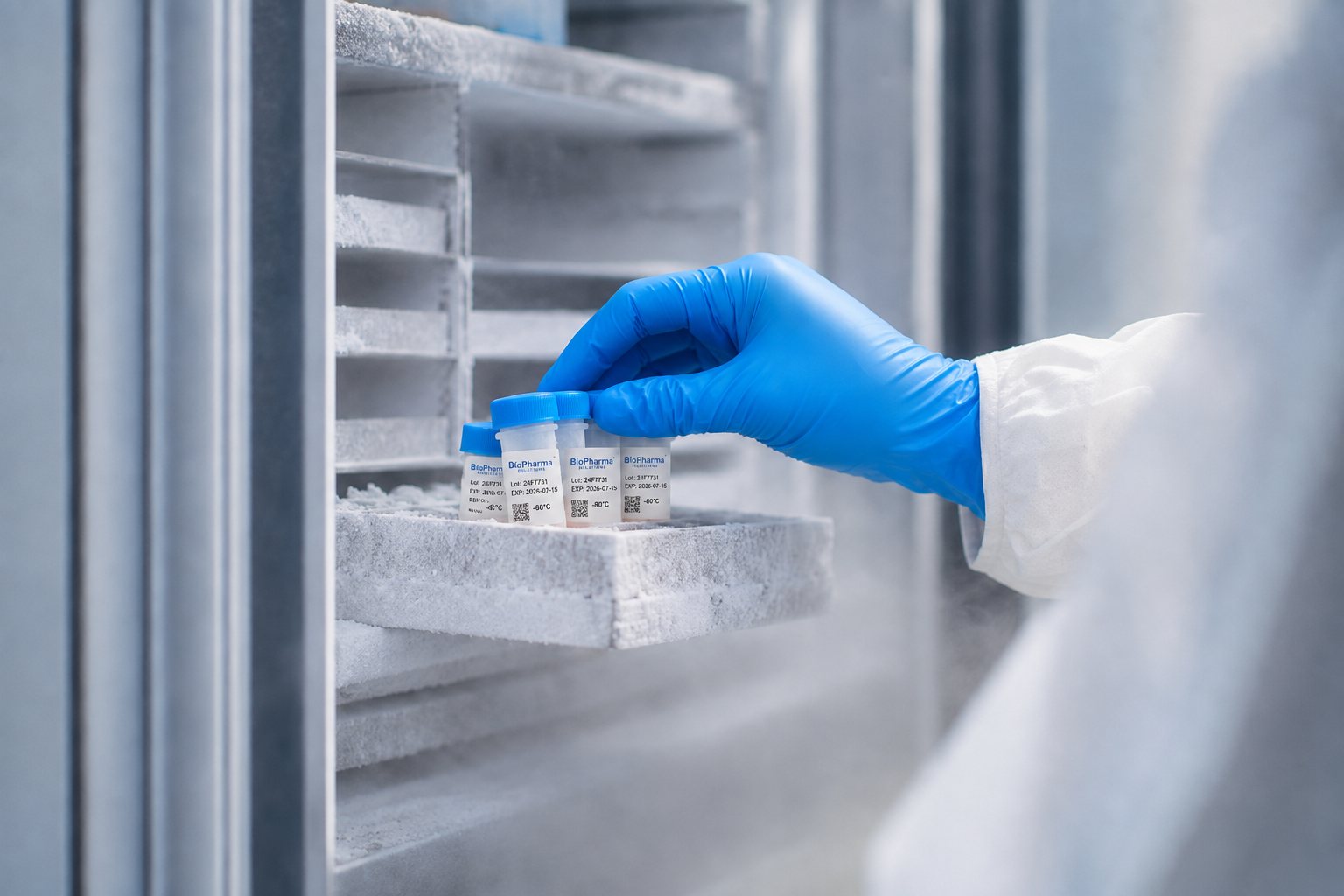
A smeared DataMatrix at pick-and-pack, a lifted corner on a cryo vial pulled from a −80 °C freezer, a rejected pallet at receiving: three failure modes, one root cause, which is a label spec chosen against a price list instead of an environment. Pharmaceutical labels have three real jobs. Stay legible. Stay adhered. Stay scannable. They have to do those jobs across cold chain, autoclave-adjacent zones, and chemical wipe-down, and they have to do them under a quality system your auditors can read.
Liberty Labels has been converting labels for regulated manufacturers since 1969, independently owned the entire time. Cryogenic adhesives are a stocked family here, not a special order. GS1-conformant serialization and RFID encoding are baked into how the presses run. And the spec conversation starts with where the label lives, not what it costs.

Most pharmaceutical label failures are upstream spec mistakes, not manufacturing defects. A paper facestock chosen on cost, a permanent adhesive on a container meant to be reused, a barcode printed too small for reliable scan at pick-and-pack. The label leaves the press correctly.
It just wasn't built for the environment it was headed into. Before we get to materials, it's worth naming the specific ways a label goes wrong in this industry:
Adhesive delamination at −80 °C and below, when a room-temperature-cure adhesive never reached full tack on a chilled vial.
Facestock brittleness in liquid nitrogen shippers, where the wrong film cracks along the die-cut edge.
Ink lift and print fade after UV and thermal cycling in cold storage, most common on direct thermal facestocks stored long-term.
Edge lift and flagging on curved vials and ampoules, where a small radius stresses the adhesive and lifts the leading edge.
Ink smear and topcoat failure from isopropyl, hydrogen peroxide, and quaternary ammonium wipes during aseptic handling.
Paper blistering in autoclave-adjacent zones at 121 °C steam, and barcode contrast loss on frosted, wet, or condensation-covered substrates.
Lot-and-expiry legibility loss when small trim sizes force copy below the point size a scanner or a human can reliably read.
Every one of those failures is preventable at spec. None of them are preventable at receiving.
Liberty Labels' quality management system is time-tested and rooted in the principles of ISO 9001 quality management and cGMP-style process control.
Documented procedures govern production, inspection, and change control. Any change to a validated SKU, whether it's a material, an adhesive, a print method, or a color, moves through documented review before it hits the press.
Supplier qualification and incoming material verification catch substrate variation before it becomes a batch problem. In-process and final inspections cover print accuracy, color matching, material conformance, adhesion, die-cut accuracy, and barcode readability, with sampling documented against the run.
Lot-level traceability sits behind every job. Production records, retained samples, and change history are kept so a validated batch can be reconstructed years after the fact if a recall or a deviation investigation requires it. Structured corrective and preventive action processes handle the exceptions that any real production environment generates, with root-cause analysis attached to the corrective step and a documented verification loop that closes it out.
For a returning customer, the retained specification and the retained physical sample are the mechanism that keeps a reorder identical to the qualified batch. That's not a service claim. It's a documented procedure, and it's what regulated buyers evaluate when they audit us.
A cryo vial comes out of a −80 °C freezer with a lifted corner. The lab tech notices it in the pull, reports it, and now a batch of samples has a chain-of-custody question attached.
The label didn't fail during storage. It failed at application, weeks earlier, when a room-temperature adhesive never reached full tack against a container that was already chilling toward its storage temperature.
The right construction for that vial is a polypropylene or polyester facestock with an acrylic cryogenic adhesive engineered to bond at low temperatures rather than reaching full tack at room temperature. Cold-flex films stay ductile at freezer temperatures instead of embrittling along the die-cut. High-contrast inks and coatings keep barcodes and human-readable text crisp and scannable in cold and humid conditions, which matters more than it looks when a scanner is trying to read a DataMatrix through condensation on a vial pulled from cold storage.
Named applications where this construction lands: vaccine and reagent vials, biobank samples, cell-therapy shippers, and prefilled syringes moving through cold-chain logistics. Small-format legibility is its own problem inside the problem. A 2 to 4 point copy line and a tight DataMatrix quiet zone on a 15 mm vial has almost no margin for print drift or facestock movement, and the material choice either gives you that margin or it doesn't.
One note on print method for the lab-printed use case: direct thermal is generally the wrong facestock for long-term cryogenic storage because the print image fades under UV exposure and thermal cycling. Thermal transfer with a resin ribbon holds up substantially better where the label is printed at the lab or the clinic. If the label is going to sit in a freezer for years, we spec accordingly.
The DataMatrix that fails at pick-and-pack almost always failed at print. Cell size too small for the substrate, quiet zone too tight against the die-cut, contrast lost on a metallic film or a frosted glass background.
The scanner gets blamed. The print spec was the problem.
Liberty produces serialized pharmaceutical labels with GS1 DataMatrix and the application identifiers that carry GTIN, lot, expiration, and serial number. Aggregation to cartons and cases is standard. For customers moving toward item-level tagging, RFID encoding and production conform with GS1 standards, with inlays selected against the container material and the read environment.
Print-quality realities that determine whether a code scans reliably at small trim: cell size against the print resolution, quiet zone against the die-cut, contrast ratio against the substrate, and verification grade against the customer's incoming standard. We run the verification and provide the report. The manufacturer or the dispenser owns the regulatory content on the label, whether that's FDA labeling expectations, DSCSA serialization obligations for the U.S. supply chain, or the equivalent in export markets.
Liberty prints the label built to carry that content. For statute-specific questions, your regulatory counsel is the right source, not us.
The point of getting this right at print is what happens downstream. A carton with a verified serialization mark clears aggregation without exception handling.
A vial with a scannable code at pick-and-pack doesn't stall the line. A recall event can traverse a lot-level trace without a human trying to read a smeared code off a case corner.
Chemical drums are the honest test of an adhesive, and the story generalizes. The label goes on at the fill line, the drum ships to a customer who wipes it down with isopropyl or something more aggressive, the drum sits outside for a season, and then, after the product is used, someone needs the label to come off cleanly so the drum can go back into service. Two contradictory jobs in one label: stay for the lifecycle, leave without residue.
The wrong answer is a general-purpose permanent adhesive on a paper facestock. The paper wicks moisture, the adhesive locks in over months of UV and heat cycling, and when the drum comes back the label tears in strips and leaves a gum layer no one wants to scrape. The right answer names the environment first: film facestock, polypropylene or polyester depending on the chemical, with an adhesive engineered for clean removal after cure, and a protective overlaminate if the drum will see abrasion in a rack.
The customer who asked us to solve this had been fighting the residue problem for two years across three suppliers. The fix wasn't a better adhesive in the abstract; it was the adhesive that matched their actual lifecycle.
The same discipline applies to autoclave-adjacent zones. Steam at 121 °C blisters paper facestocks and curls the edges of a polypropylene chosen without regard for the adhesive's heat stability.
What survives repeated cycles is a polyester facestock with a heat-stable adhesive and thermal-transfer print laid down with a resin ribbon. Autoclave resistance is meaningless as a spec without a cycle count and a reuse-versus-single-use decision attached, so we ask both questions before quoting.
Chemical wipe-down environments demand a topcoat and a facestock that survive isopropyl, hydrogen peroxide, and quaternary ammonium without ink lift or edge whitening. UV coating or an overlaminate handles the abrasion side. For reusable containers, the adhesive has to release cleanly at end of life without leaving residue that fails the wash.
Cold-chain excursion adds moisture and temperature swing to the equation, most sharply when a package moves from dry ice back to ambient and condensation forms on the label surface. Moisture-resistant constructions, not waterproof claims, are what the spec calls for.
Tamper evidence is a construction decision, not a sticker. A VOID overlay on the wrong topcoat can fail to reveal, or reveal too easily during normal handling and generate false alarms at receiving. What works is a matched system: destructible facestock or a purpose-built void construction, a security overlaminate where abrasion is a factor, and a topcoat chosen against the closure and the container.
Controlled-substance labeling is a customer regulatory obligation Liberty's labels are built to support, never one Liberty certifies against, and the specific statement language belongs with the manufacturer's regulatory function. A dedicated anti-tamper page is in development; we'll cross-link when it's live.
Liberty doesn't sell applicators. We spec labels that run cleanly on the ones you already own.
The "pharmaceutical labeling machine" search sends most buyers to equipment vendors, but if the label doesn't come off the roll clean, the machine spec doesn't matter, and the label spec is where the fix lives. When a customer sends us the applicator make and model along with the current roll spec, we match the label to it and validate on our end before the roll leaves the building.
Here's the information to send with a quote request so we can spec the roll correctly on the first try:
Applicator make and model, and whether it uses gap or black-mark sensing.
Core size (typically 3" for high-speed pharma applicators, 1" for benchtop and lab printers).
Unwind direction (positions 1 through 8) and maximum roll diameter.
Labels per roll and any splice tolerance the applicator will accept.
Matrix cut or butt cut, and the required leader length.
Finishing is available in rolls, sheets, and continuous fanfold. If you're running validated equipment, we run to it. If you're specifying a new line, we'll work with the equipment vendor on the roll geometry that the machine expects.
Consider the scenario this work is built for. A biotech manufacturer qualified a label SKU eighteen months ago, and the incumbent supplier now pushes lead times past six weeks in the middle of a validated production window.
Requalifying against a new supplier means a documented material match, a documented print-method match, a color qualification, and a sample run the QA team can sign against the retained batch. What it does not mean, and what no quality group should accept, is a silent cost-driven material substitution three months into the relationship.
The mechanics of a clean switch are boring on purpose. Send us the current label or a physical sample. Send the applicator spec and the environment the label lives in. Send whatever regulatory content the label has to carry.
If clean artwork files are gone, which happens more often than anyone admits after a decade with an incumbent, we can recreate the artwork from an existing label or a high-resolution photo. A hard proof handles physical color matching where a digital proof won't. A sample run on production materials goes to QA before commit, so the qualification is done against the label that will actually be produced, not a mock.
After qualification, the retained specification and the retained physical sample keep every reorder identical to the batch QA signed against. The risk in switching a validated SKU is not the new supplier making a mistake at the press. It's the new supplier making a silent, cost-driven material change six months in. We won't do that, and we tell you what we ran.
Liberty has been independently owned since 1969, more than fifty-five years, with 150-plus years of cumulative label industry experience across the team. Customer retention among active accounts approaches 100%. There's no minimum order quantity.
Lead times are competitive, and the shop regularly accommodates rush requests when a customer's line is at risk. Spot color matching and color consistency across reorders are documented, not aspirational. Read more about the shop and how it operates on our about page.
What that means practically for a QA lead in month fourteen of a supplier qualification: no ownership disruption mid-validation, no acquisition integration chaos routing your point of contact through a new call center, no unannounced personnel turnover walking a validated SKU's history out the door. The person who ran your first qualification run is the person answering the phone when you call about reorder eight.
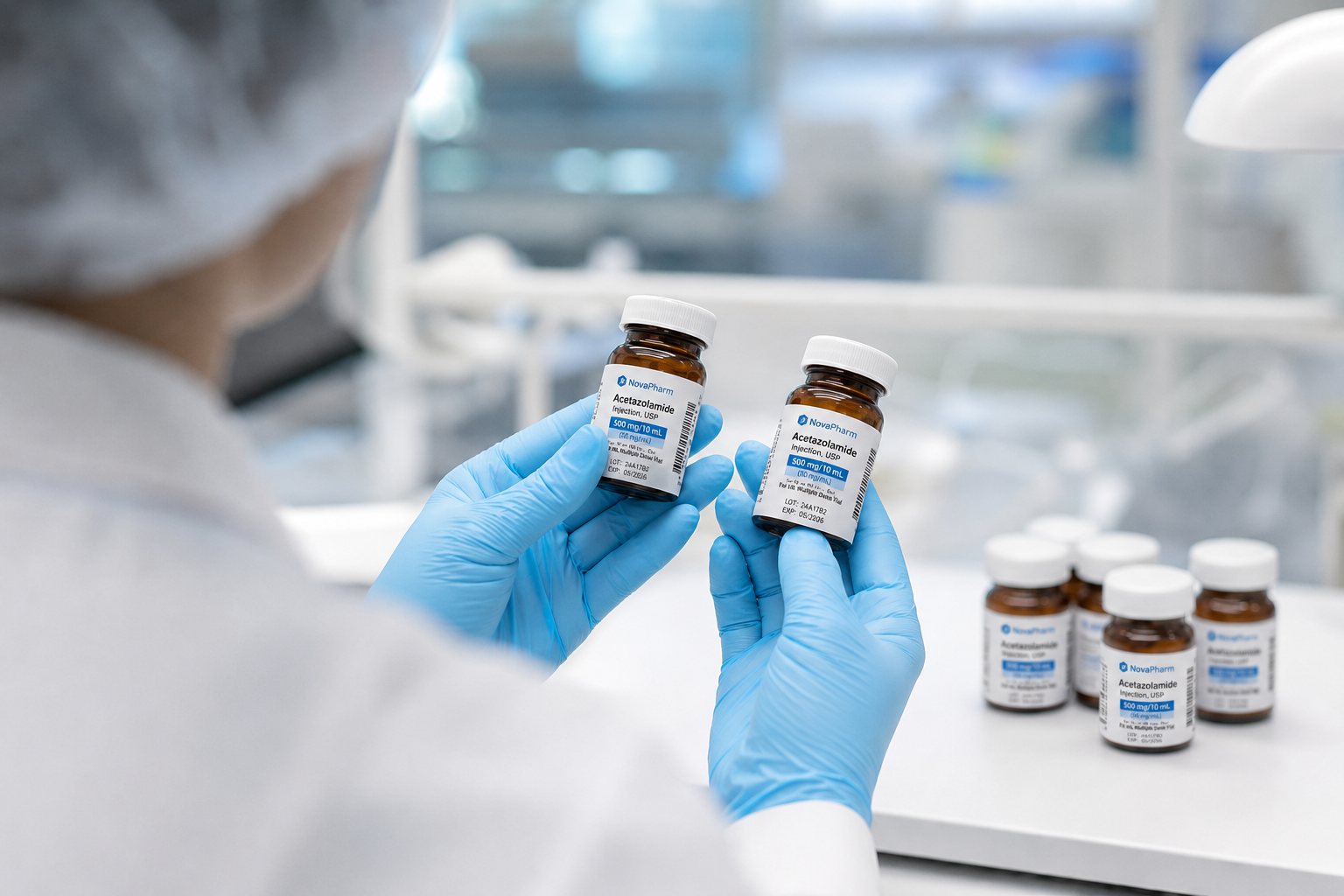
Liberty Labels' quality management system is time-tested and rooted in the principles of ISO 9001 quality management and cGMP-style process control. That means documented procedures for production, inspection, and change control, supplier qualification and incoming material verification, in-process and final inspection, lot-level traceability with retained samples, and structured CAPA. Liberty is not ISO 9001 certified. Our quality philosophy is risk-based and practical: apply the right controls for the application, document what matters, and continuously improve.
Yes. GS1 DataMatrix with application identifiers for GTIN, lot, expiration, and serial number is standard. Aggregation to cartons and cases is supported. For item-level RFID, encoding conforms with GS1 standards and inlays are selected against the container material.
Yes. Polypropylene and polyester facestocks handle glass and plastic vials, and cold-flex films stay ductile where cold-chain storage is involved. Small-format print runs at cell sizes and quiet zones sized to scan reliably at pick-and-pack. Ampoule and prefilled-syringe geometries are routine work here.
Yes. Cryogenic is a stocked adhesive family, not a special order. Acrylic cryogenic adhesives are engineered to bond at low temperatures rather than reaching full tack at room temperature, which is the reason a paper-and-permanent construction lifts in a freezer. Named use cases include vaccine and reagent vials, biobank samples, and cell-therapy shippers.
Yes, and it's the recommended path for any validated SKU. Digital proofs handle content and layout, hard proofs handle physical color matching, and a sample run on production materials goes to your QA team for qualification against the batch you're replacing. You can start that conversation through our quote request.
Yes. Send the existing label or a physical sample, your applicator spec, the environment the label lives in, and any regulatory content the label carries. Liberty matches material, adhesive, print method, and color, and produces a sample run for your QA team before commit. After qualification, retained specifications and retained physical samples keep every reorder identical to the qualified batch.
Yes, if we spec the roll to your machine. Send applicator make and model and the current roll spec: core size, unwind direction, roll diameter, and gap-versus-mark sensing. Finishing is available in rolls, sheets, and continuous fanfold. For high-speed pharma applicators, 3" cores are typical; for benchtop and lab printers, 1" cores are standard.
The fastest way to a clean switch is a sample in QA's hands, not a longer sales conversation. Send us the current spec, a physical sample if you have one, the applicator make and roll spec, and the environment the label lives in. We'll return a matched quote and a sample run your team can qualify against the retained batch.
Start the conversation through our request a quote page, or reach the shop directly through the contact page. Bring the label you're trying to replace and the environment it has to survive.
Request a Quote