Every failed pressure-sensitive label is a spec failure. The label lifted off the drum because the adhesive was wrong for the surface, or delaminated in the freezer because the facestock wicked moisture, or cracked at the corner because a squeezable container met a film with no give. A technical supplier catches that before the die hits the press.

We work with the procurement, packaging, and operations people who already know what a label is and need to know whether the shop on the other end can spec the job. Our process begins with a conversation about the container, the environment, and the run, not with a price quote. If a customer arrives with a spec, we quote it.
We also flag a better option when one exists. Most quality problems we see are specification problems in disguise, and the fix is asking three more questions before the press turns.
The two terms are synonyms. "Self-adhesive" is the common European term; "pressure-sensitive" is the North American industry usage carried by TLMI and the trade press.
The bond forms on contact, no water, heat, or solvent required. Alternative label technologies exist (glue-applied, shrink sleeve, in-mold), but if the term you're searching is "self-adhesive," you're already in the right place.
Every pressure-sensitive label has a facestock (the printable surface), an adhesive (the bond), and a release liner (the carrier the label peels from on an applicator). Most competitor pages diagram those three and stop.
The two layers that decide whether a label actually prints cleanly and unwinds on a co-packer's line are the ones they leave out: the topcoat that accepts the ink and coating without ghosting, and the release coat that lets the label separate from the liner at production speed without tear-off. When a label prints beautifully in the shop and jams on the customer's applicator a week later, the release coat is usually the reason.
Before naming a material, ask where the label has to live. Facestock divides cleanly into paper and film; adhesive is an engineering decision, not a menu; finish is where prime work earns its shelf appeal. Each row is an option, what it solves, and when to spec it.
Water resistance is not a facestock. It's a combination of facestock, adhesive, and either an overlaminate or a UV coating protecting the print from the water the label has to survive. A BOPP face with a permanent acrylic adhesive and a gloss overlaminate holds up in a cooler for years; the same BOPP with a paper-grade adhesive and no overlaminate will not.
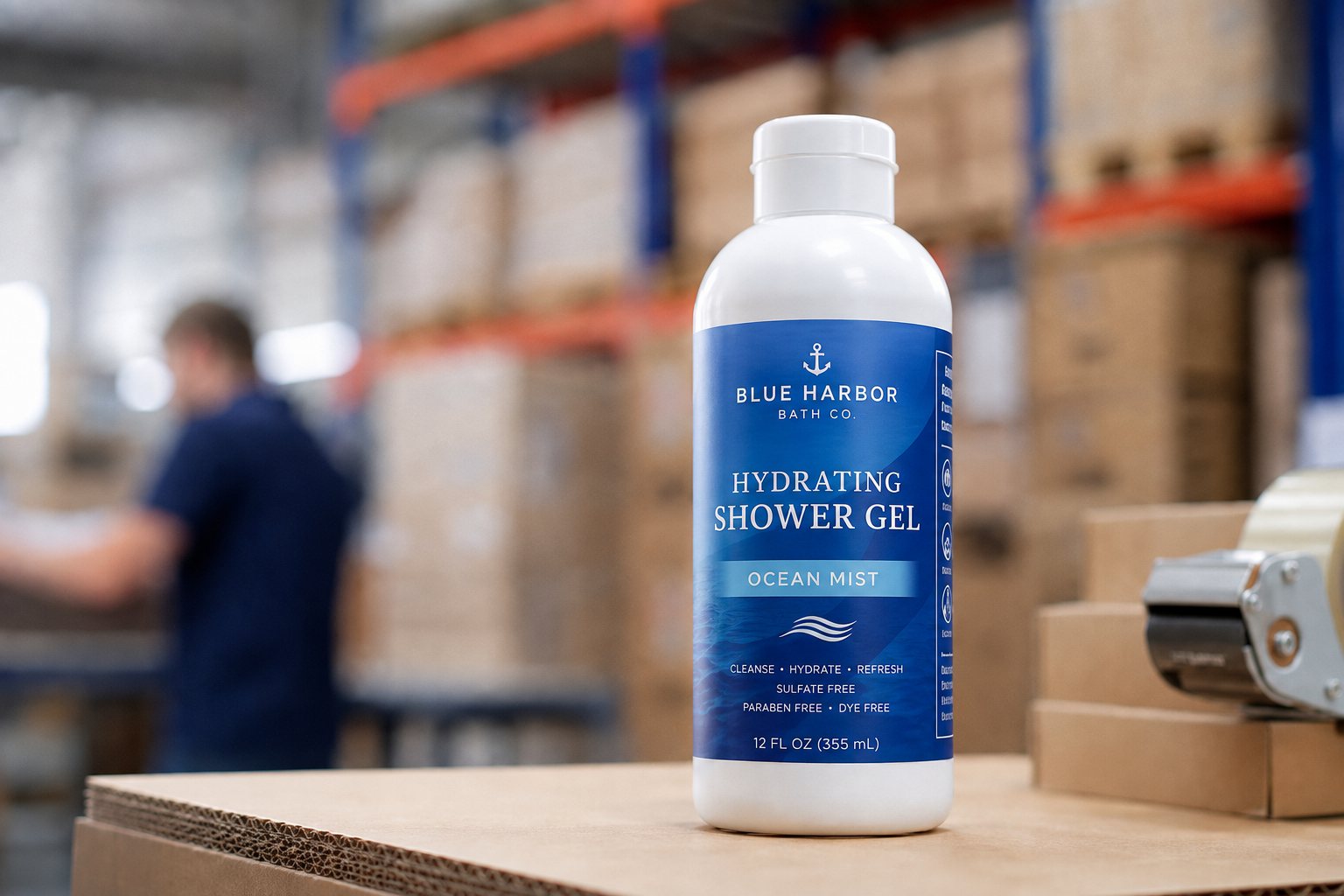
Picture a 5-gallon HDPE pail sitting in a freezer aisle with the label flagging up at three corners. The artwork is fine. The material is film.
The label lifts anyway. That's an adhesive that couldn't wet a curved low-surface-energy plastic at temperature, and it's the single most common failure we see on new accounts. Adhesive is not a menu.
It's an engineering decision driven by the container's surface energy, the storage temperature, moisture and chemical exposure, and how long the label has to stay on. Every adhesive claim without a temperature range is marketing. If a supplier can't tell you the range and the surface energy the adhesive was formulated for, they're guessing.
A chemical manufacturer needed a drum label that would stay on through a year or more of outdoor exposure, chemical splash, and rough handling — then release cleanly when the drum was reconditioned. Those requirements normally live on opposite ends of the adhesive spectrum. The build we spec'd was a specialty film with a formulated removable adhesive rated for prolonged chemical exposure. It held for the product life and came off in one piece at recovery. When the label also carries GHS pictograms and marine transport marks, BS 5609 sections 2 and 3 come into the conversation.
On wash-off: the sustainability claim depends entirely on whether the customer's recovery stream can remove it at the right temperature and caustic level. Half the sustainability talk in this industry is theater, and we'd rather say so than sell a label that greenwashes. We've been FSC® chain-of-custody certified since 2022 and can supply FSC® certified facestocks and liners on request when the sustainability story needs to be verifiable rather than aspirational.
Roll, sheet, or continuous fanfold is a production question, not a preference — and a co-packer will ask three specs before accepting the roll. Print method follows run length and SKU count, not preference. A shop that only pushes one press method is telling you what it has, not what you need.
Fits pilots, seasonal SKUs, high-mix work, and any job with variable data (lot numbers, serialization, per-label QR codes) printed inline. No plate setup, so low quantities and frequent artwork changes stop being expensive. Pantone matching within digital's gamut; certain metallic and neon spots still need flexo.
Pays back on the SKUs you rerun quarterly at volume, where color consistency across long runs matters more than fast setup. Wider spot-color palette and better per-label economics. Hybrid work is common: a flexo base plate for brand elements, digital overlay for variable data.
We offer CMYK four-color process with up to four spot colors, spot color matching, and color consistency across reorders. Send a physical sample if you have one; if you don't, a clear photo of the labeled container works. We can recreate artwork from an existing label and produce a hard proof for physical color matching before the run.
Two questions decide the first call: what does the label have to survive, and what's the run?
Regulated categories need constructions that support the customer's compliance obligations. We supply the label; the customer's product carries its own approvals. If a supplier tells you their label is "FDA approved," walk away.
Labels don't get approved. Products do, and the supplier who confuses that will confuse other things too.
Pressure-sensitive is the base construction under most of the categories we serve. The market pages carry the industry-specific compliance and format detail.
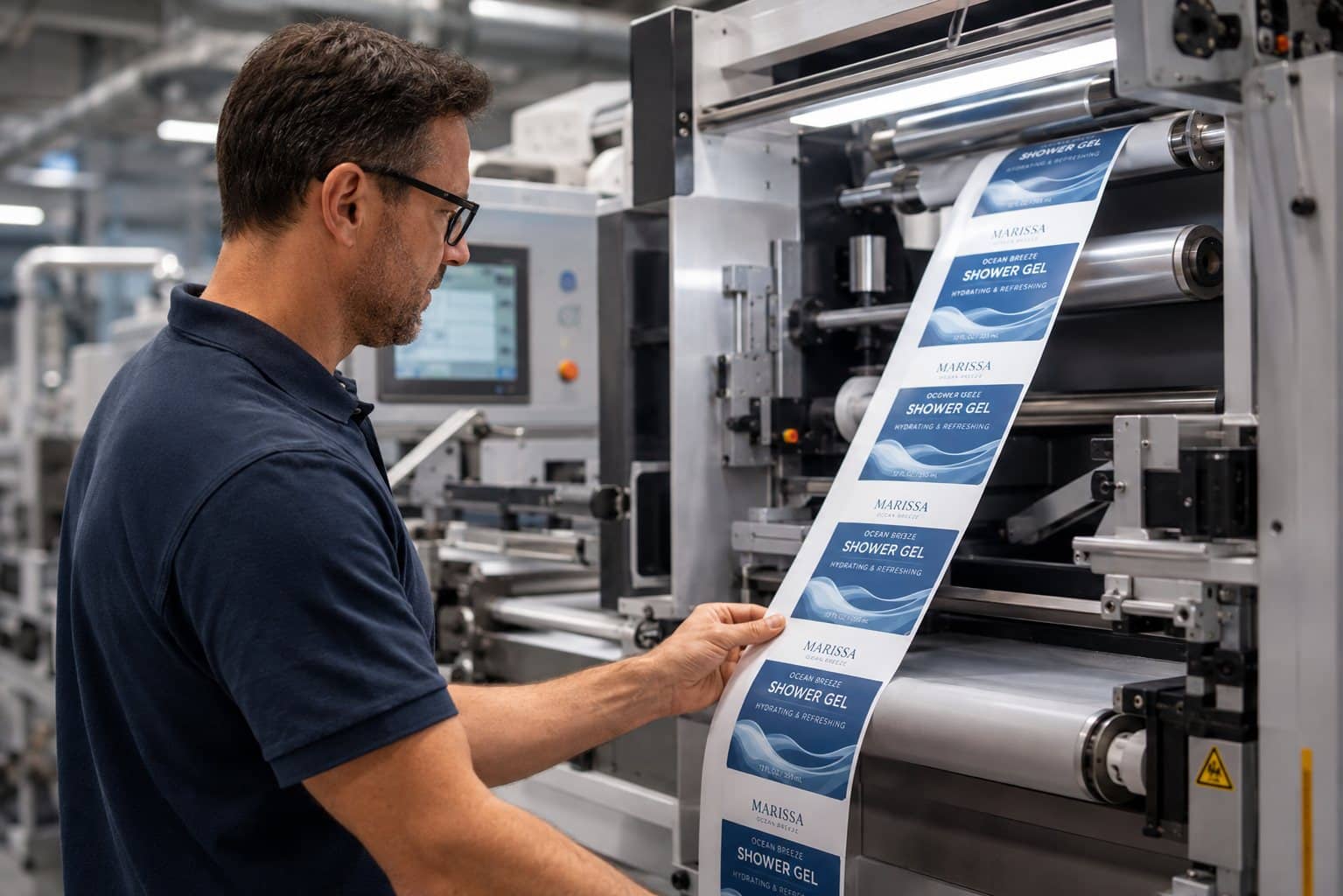
A food manufacturer called on a Wednesday afternoon. Their existing supplier had stopped answering. They had a production line queued to run in 48 hours and no labels.
We moved millions of labels to their dock in that window, matched to the specs and physical sample they emailed over that night. The reason we could is the same reason our reorders arrive consistent a year after the first run: we retain job specifications and physical samples from every prior run, and our quality system is rooted in the principles of ISO 9001 and cGMP-style process control.
That means documented procedures, lot-level traceability, in-process inspection against the retained sample, and a structured CAPA loop when something drifts. We're not certified to ISO 9001 or cGMP; we operate to their principles, which is the honest way to say it.
A federal agency put out an RFQ that named a specific branded facestock and called for extreme durability. We could have quoted it as written and won on price. Instead we ran the application diagnostic and identified an alternate material that would perform identically at 33% lower cost.
We proposed the swap with data, the agency accepted, and it became our largest federal contract to date. Half the specs we see on RFQs are the last supplier's product number in disguise. A real technical partner reads the application before it reads the spec.
Liberty Labels has been independently owned since 1969, based in Fort Scott, Kansas, with a team carrying more than 150 years of cumulative label industry experience. No private equity, no revolving management. Customer retention among active accounts approaches 100%.
We hold SBA HUBZone certified small-business status, which supports prime contractors' supplier-diversity goals on federal work. One customer put it better than we could: he likes to buy his meat from the rancher. That's who we are.
Paper suits dry, indoor use and short shelf life. Film (BOPP, PP, PET, PE) handles moisture, chemical exposure, freezer, outdoor UV, and curved containers. Paper is less expensive per label; its failure mode is wicking moisture and delaminating. Most lifting-corner problems on new accounts started as paper that should have been film.
Yes, custom pressure-sensitive labels in paper, film, and specialty stocks, with no minimum order quantity. The right material depends on the container surface, the storage environment, and the shelf life the label has to reach. Those are the three questions we ask before quoting anything.
Both, plus continuous fanfold. Rolls for automated applicators, spec'd to core ID, roll OD, and unwind direction on request. Sheets for laser printers and short manual jobs. Fanfold for high-volume thermal transfer work. Tell us the applicator or printer model and we'll match the format to the equipment.
It depends on the container's surface energy, the storage temperature, and how long the label has to stay on. Six families to choose from: cryogenic, permanent, removable, repositionable, all-temperature, and wash-off. HDPE and polypropylene need high-tack for LSE. Freezers need cold-flow chemistry. We spec by environment, not by catalog.
Yes. Send a physical sample if you have one. If you don't, a clear photo of the labeled container works. We can recreate artwork from an existing label and produce a hard proof for physical color matching before the run.
Yes. Send us the application (container, environment, run size, run frequency) and we'll produce samples on the materials we would actually recommend, not just what happens to be on the shelf.
We've held FSC® chain-of-custody certification since 2022. FSC® certified facestocks and liners are available on request when the sustainability story needs to be verifiable.
Competitive lead times with rush accommodation as a standard capability. We've moved millions of labels in 48 hours to keep a customer's production line running. Send us the application and we'll tell you honestly what's possible. No day-guarantees over the phone.
Yes. We ship from Fort Scott, Kansas to customers across the United States, Canada, and Mexico. The central location supports timely delivery across North America.
The fastest quote you'll get from us is the one where you tell us what the label has to survive, not just what it has to say. Describe the container, the environment, and the volume.
We'll come back with a recommended construction and, when there's a better material than the one you asked for, we'll flag it. Competitive lead times, and we regularly accommodate rush requests.
Request a Quote