A polyethylene drum sitting in a Kansas yard cycles from 105°F in July to 5°F in January, and the label that held through the summer is the one peeling at the corner by February. The operational cost isn't the label. It's the re-labeling labor at the wash bay, the hazcom exposure while a pictogram is unreadable, and the argument with the customer whose shipment arrived with a torn GHS panel.
Industrial labels earn their keep across six environments: chemical and solvent contact, UV, abrasion, temperature swing, moisture and wash-down, and mechanical peel. Paper facestock and generic acrylic adhesive lose in all six. What follows covers the compliance formats industrial buyers ask about, the materials that hold up, the adhesive calls that decide whether a label stays where you put it, and how we spec the job before we quote it.

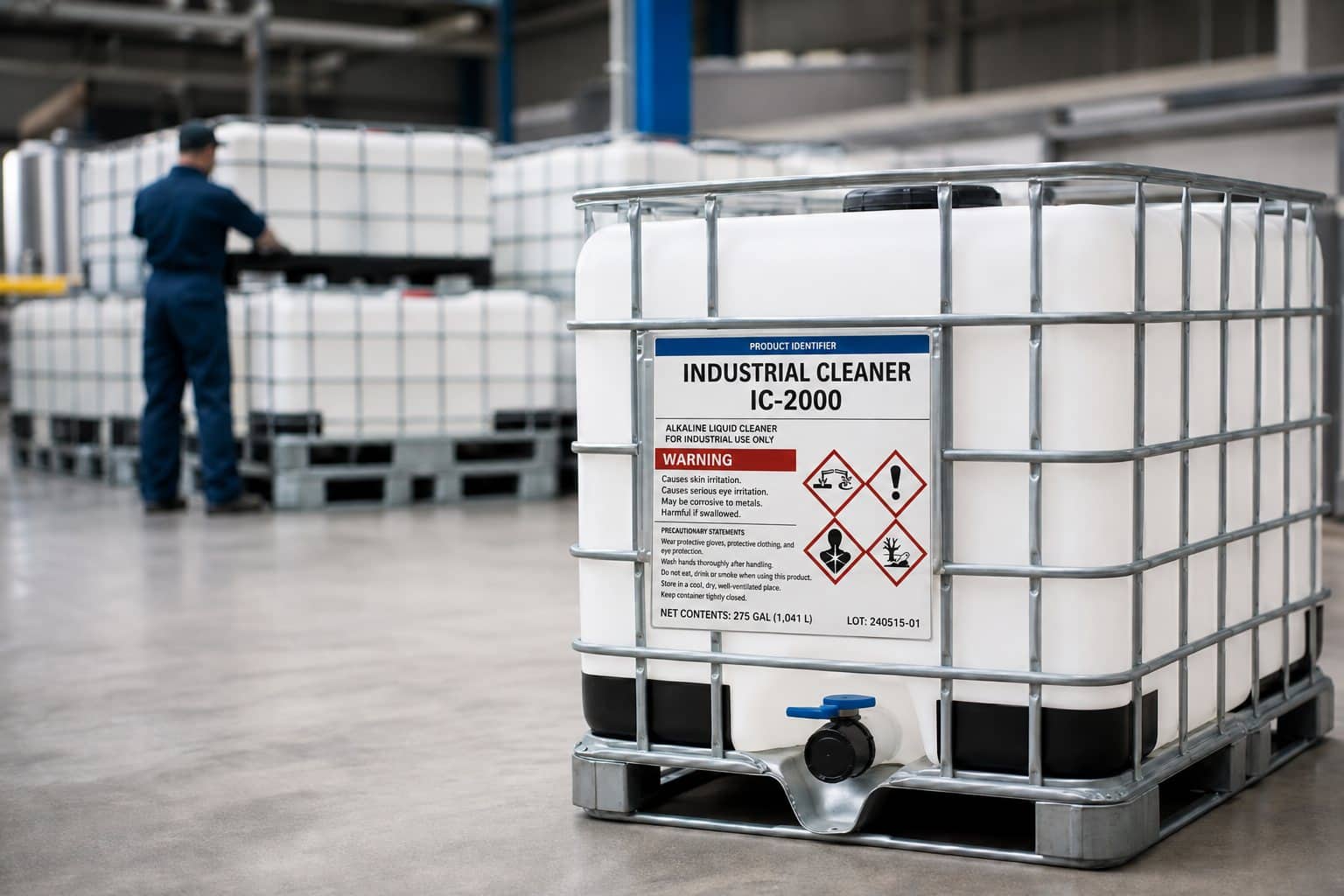
GHS governs the pictograms, signal words, and hazard statements that appear on chemical containers under OSHA HazCom in the U.S. and the equivalent regulations elsewhere. What matters on the print side is that the pictograms stay legible and the label stays adhered through the container's working life. Small drums get scuffed against pallet racking.
Secondary containers get wiped down daily. IBCs get rained on.
A GHS label printed on paper with a general-purpose adhesive is a compliance problem waiting to be written up. We produce GHS-format labels sized and printed for the container, with facestock and adhesive matched to the environment; your EHS or regulatory team owns what the label says.
DOT hazmat marks and labels for shipping containers face a different set of stresses: repeated handling, weather during transfer, moisture, and the friction of transit. The regulatory content is fixed by the shipping classification.
Our job is a label construction that arrives at the destination as readable as it left the plant.
BS 5609 is the standard almost every supplier page skips even while naming drums as a use case. It governs labels on chemical drums shipped by sea, and it's a construction-level standard: specific facestock, print, and adhesive requirements that together survive extended saltwater immersion and marine handling.
If your drums cross an ocean, BS 5609 is the standard that governs, not GHS alone. We build label constructions to those requirements, and we route the compliance wording through your team before it prints.
The environment picks the material, not the other way around. A label headed for outdoor asset service on painted steel is a different construction than a label going on a polyethylene spray bottle that gets wiped with isopropyl alcohol every shift, and both are different from a drum label that has to survive an ocean crossing.
A label has four layers doing the work: a topcoat that carries print and abrasion, a facestock that carries structure, an adhesive that carries the bond, and a liner that gets thrown away. Where each layer earns its cost is the whole question.
Here is the short version, paired by environment:
Topcoat and overlaminate are different tools. A topcoat is a coating applied to the printed facestock that resists abrasion and mild chemical contact. An overlaminate is a separate film laminated over the print that adds thickness, chemical resistance, and UV protection.
Buyers over-spec laminate on indoor jobs and under-spec it on outdoor ones, often on the same project. If the label lives outside, the overlaminate is doing most of the work keeping the print readable.
We carry a range of adhesives: cryogenic, permanent, removable, repositionable, all-temperature, and wash-off. The reason to have that range is that the container decides the adhesive, and the containers industrial buyers actually name span a huge behavioral gap. High surface energy substrates like glass, stainless steel, and painted steel accept a standard permanent acrylic and hold well.
Low surface energy (LSE) plastics like polyethylene and polypropylene fight adhesion. A standard permanent acrylic on an LSE bottle will look fine on day one and lift at the corners by week three. The fix is an LSE-rated acrylic, not a stronger generic one.
Two spec questions decide most jobs before chemistry ever enters the conversation. First, what temperature is the label being applied at? Adhesive wetting-out is a slow process, and most permanent acrylics don't reach full bond strength for 24 to 72 hours.
The plant installs the label at whatever temperature the plant is at. Spec the adhesive for that temperature, not the storage temperature, because the label doesn't get warmed up before it goes on the drum. Second, how long does the label have to dwell before the container moves?
If the container ships or freezes the day it's labeled, the adhesive hasn't finished bonding. That's a schedule problem masquerading as an adhesive problem.
A steel drum takes a permanent acrylic well and holds a GHS panel through years of service. A polyethylene drum is LSE and needs an adhesive rated for it, or the label lifts. A returnable IBC introduces a real tension: the same label has to survive the product's use cycle and come off cleanly when the tote returns for wash-out and refill. That's what wash-off adhesives are built for. For marine shipment, BS 5609 drives the whole construction, facestock included. Where the container ships by sea, that standard is the spec conversation, not a footnote to it.
Polyethylene and polypropylene spray bottles are LSE. The question we hear most is why a label lifted after a few weeks of daily wipe-downs. Nine times out of ten the answer isn't the alcohol. It's that the adhesive was a general-purpose permanent acrylic instead of an LSE-rated one, and the bond never fully formed on the plastic. The topcoat handles the wipe chemistry on the surface, the LSE adhesive handles the bond underneath, and the two together survive shifts of daily cleaning. If the wipe-down chemistry gets more aggressive than isopropyl alcohol, tell us what it is. Ketones and aromatic solvents drive a different topcoat spec than mild alcohols.
Painted steel, powder coat, and cast aluminum each behave differently. Powder coat is a lower-energy surface than bare painted steel and often needs an adhesive rated for it. Cast aluminum with a textured surface reduces the actual contact area between label and substrate, which changes both the adhesive choice and how much dwell the label needs before it moves. Outdoor UV, mechanical handling, and impact are the environmental load. A 6-mil overlaminate over a polyester facestock is what carries sustained outdoor exposure on this class of label. The facestock alone can't do it.
A chemical manufacturer running a returnable-drum program came to us with two requirements that read like opposites: the drum label had to hold permanently through the product's use cycle, including temperature swing, outdoor storage, and wipe-downs, and it had to come off cleanly when the drums returned for wash-out and refill. With a standard permanent acrylic, "came off cleanly" meant torn facestock, adhesive residue that needed a solvent to remove, and extra labor at the wash bay on every returning drum. The wash line was slower than the fill line, which meant the returnable program was quietly costing more than the buy-new-drums program it replaced.
The spec question we asked was what the label had to survive during service versus what it had to do at end of life. Once those were separated, the answer wasn't "permanent" or "removable." It was a wash-off adhesive matched to the drum substrate and to the wash-bay chemistry, so the label held through everything the field could throw at it and released cleanly under the wash cycle the plant was already running.
The operational lesson: permanent and removable are marketed as opposites, but the real problem industrial buyers have is a label that behaves like permanent during use and removable at end of life. That's a spec, not a compromise.
Equipment nameplates, asset tags, and control-panel markers are a different job than container labels. The environment is outdoor UV, mechanical handling, wash-down, and sustained service rather than chemical contact. The failure mode is usually fading print or a lifted corner, not adhesive attack.
Where variable data matters: serial numbers, asset IDs, and barcodes for tracking programs. Where it doesn't: fixed-content warning and identification plates that print once and never change. Our thermal transfer and variable data pages cover the ID-tracking side of that work in detail.
On our largest federal contract to date, we identified a 33% material savings for a federal agency whose RFQ named a specific branded material for a durable outdoor label. The named material would have performed. A functionally equivalent film we already ran would perform identically for the specified environment at meaningfully lower cost.
We flagged the alternative, the contracting officer approved it, and we won the award. That behavior isn't unique to federal work, but it happens on federal contracts more often because RFQs there tend to name specific specs by brand.
SBA HUBZone certification matters here because prime contractors carry small-business subcontracting goals, and HUBZone-certified suppliers help them meet those goals under federal procurement terms. Beyond that, government industrial label work leans on MIL-SPEC durability, UID and IUID marking accuracy for asset tracking, and hard-deadline delivery with real contractual consequences.
It's a category where "we'll spec you a better material than the RFQ called for" is a real behavior, not a slogan, and where the ability to say so plainly earns the next award. More on the HUBZone side lives on our government contractor page.
Our process begins with a conversation and an application diagnostic rather than a price quote. Before we quote, we work through where the label will be used, what environment it must survive, what it must do (permanent, removable, or both), what compliance context governs it, and what substrate it's actually going on. The order matters.
A quote written against the wrong substrate is a re-labeling program dressed up as a cost saving, and we'd rather ask five questions on Tuesday than reprint the job in November. Independently owned since 1969, with more than 150 years of cumulative team experience, we've had the substrate-and-solvent conversation enough times to know which questions save arguments later. Our quality system is rooted in the principles of ISO 9001 and cGMP-style process control: documented procedures, supplier qualification, in-process inspection, and lot-level traceability, so a reorder next year runs the same as the job that ran this year.
We offer competitive lead times and regularly accommodate rush requests when a label fails in the field and a line is down. More on what we run and how we run it on the capabilities page.
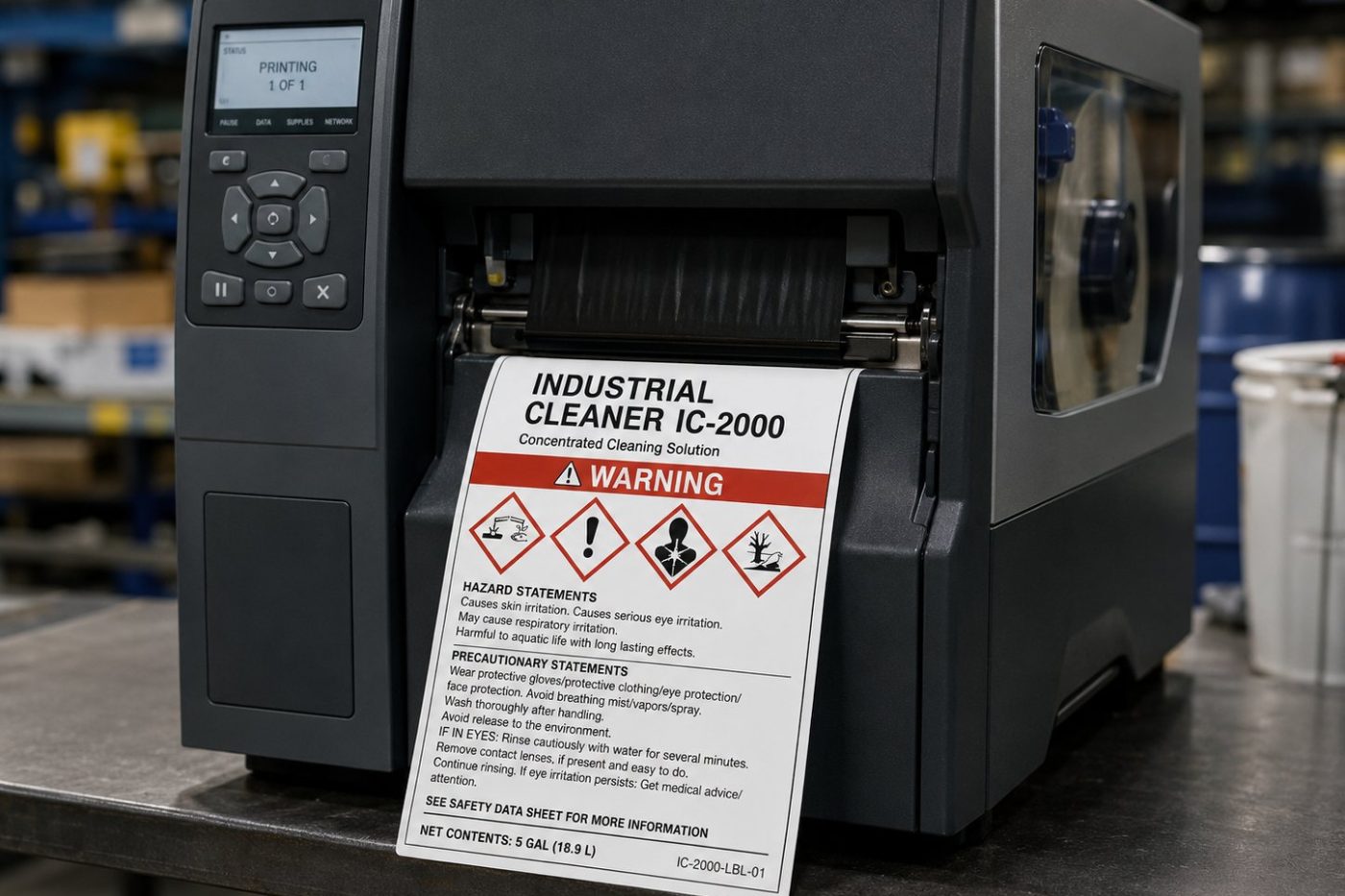
Yes. We produce GHS-format labels sized and printed to carry the pictograms, signal words, and hazard statements your regulatory team specifies. The customer owns the compliance content. We make sure the label format, facestock, adhesive, and print survive the container and the environment it lives in.
Yes. BS 5609 governs labels on chemical drums shipped by sea, and the standard combines specific facestock, print, and adhesive requirements to survive extended saltwater immersion and marine handling. We produce label constructions built to those requirements for marine drum shipment, and route the compliance wording through your team before it prints.
Polyester and topcoated polypropylene handle most industrial exposure, including isopropyl alcohol, mild solvents, oils, and common cleaners. Ketones, aromatic solvents, and aggressive brake cleaners drive a different spec. Tell us the specific chemistry the label will see and we'll match the facestock and topcoat to it rather than guessing.
Yes. A polyester facestock with a UV-rated overlaminate is the construction for sustained sun exposure, and the overlaminate is the piece carrying that protection. Unlaminated print fades first, regardless of facestock, so the laminate is where the outdoor claim lives.
Yes. That's exactly what wash-off adhesives are built for, and it's a spec we've solved on returnable-drum programs where the same label had to hold through the product's use cycle and release cleanly at the wash bay. The adhesive gets matched to both the container substrate and the wash chemistry the plant is already running.
Yes. Send us a sample or a photo, tell us what surface it's on and what it's exposed to, and we'll diagnose whether the failure is adhesive, facestock, install condition, or surface prep, then spec the replacement. We have no minimum order quantity, so a small first run to validate the fix isn't a problem.
Yes. For chemical, outdoor, or high-temperature applications, field testing the label in your actual environment before a full production run is the right call. Ambient lab tests can miss what a real plant floor does to a label, and samples in your hands answer questions a spec sheet can't.
The RFQs that get quoted fastest name a substrate and a solvent in the first sentence. Tell us the container material (steel drum, polyethylene tote, powder-coated tank, cast aluminum nameplate), the environment it lives in (outdoor UV, cold storage, wash-down, marine shipment), the chemistry it will see (isopropyl alcohol, ketones, brake cleaner, none), the compliance context (GHS, DOT, BS 5609, MIL-SPEC), and the quantity and format you need.
If the environment is unusual, ask for samples to test before the full run. Request a quote here and we'll spec it in one round instead of three.
Request a Quote