
You have a letter from a retailer, with a date on it. Next to it on your desk is a spec sheet that names EPC Gen2, references ISO 18000-6C, and lists an ARC letter code you haven't decoded yet. Walmart. Target. Dick’s Sporting Goods. Lowe’s. Nordstrom. Macy’s. Different programs, same problem: a date, a spec, and a supplier decision to make.
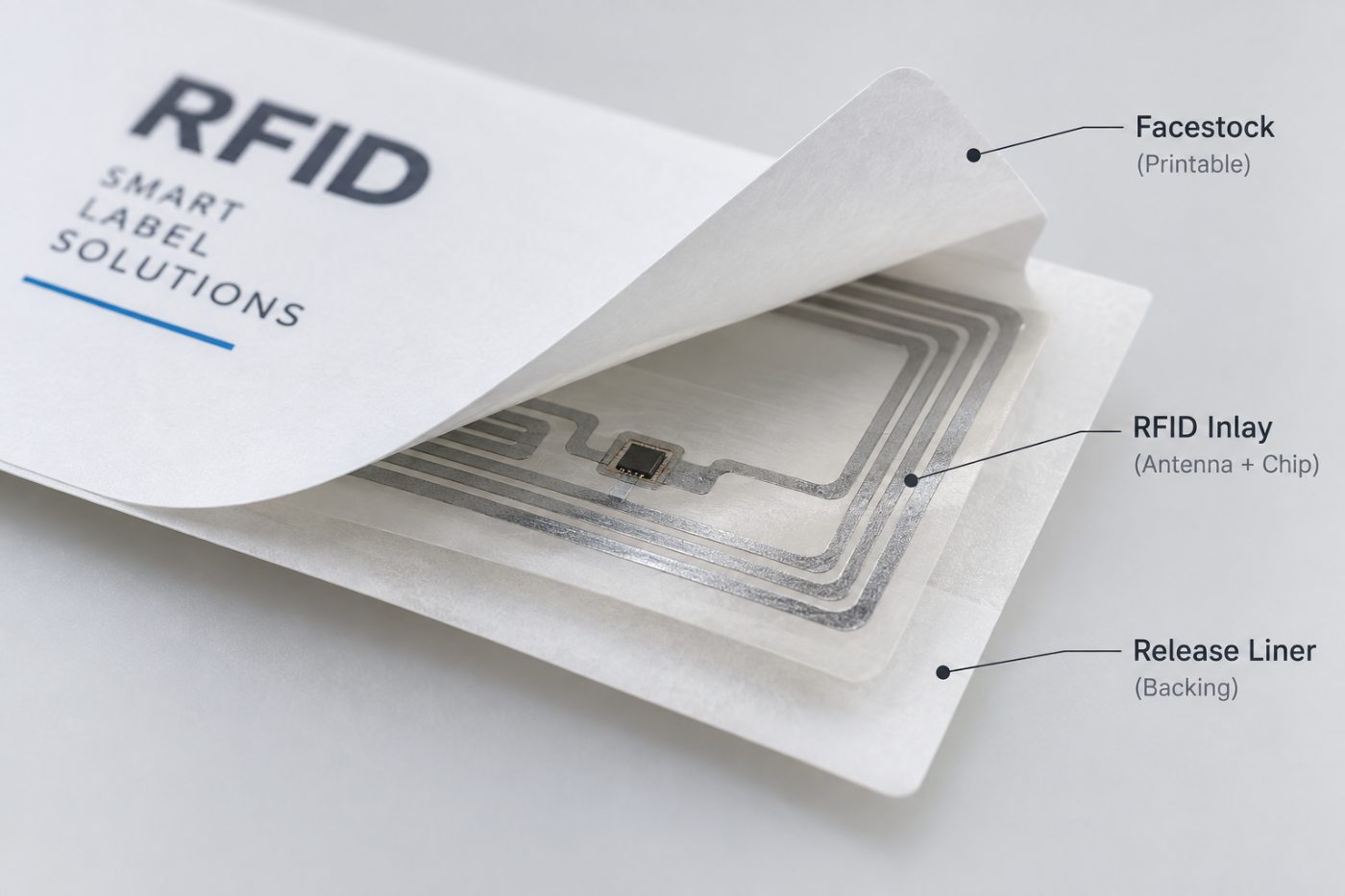
What the spec sheet actually asks for is narrower than it looks. Encoded inlays that conform to EPC Gen2 / ISO 18000-6C, carrying a GS1 SGTIN encoded to your company prefix, passing a specific ARC-graded application class — those single-letter codes (F, O, Q, R, W5, W6) point at exactly that. The retailer's lab tests the finished label on the actual carton or garment, not a test cart in a conference room. That's where pilots stall. An inlay that reads perfectly in a clean environment can lose most of its range on a foil-lined bag, a can, or wet corrugate — and "Gen2-compatible" alone doesn't survive that test.

You will read a lot about frequency bands before anyone tells you which one you are buying. For the applications this page covers, the answer is settled before you start shopping. Here is the fast version so we can move on.
Passive UHF has no battery, delivers roughly 3 to 15 feet for a standard inlay and 30 to 40 feet for a large tag designed for range, and lasts 10 to 20 years. Active tags add a battery and 300+ feet of range with a materially higher unit cost and a 3 to 7 year battery life. Every application covered here, retail source tagging, cartons and pallets, cold-chain trays, and outdoor asset tags, sits in UHF passive, governed by EPC Gen2 (ISO 18000-6C, with Gen2 v3.0 ratified in January 2024). If your reader hardware, retailer spec, and use case all point at UHF passive, and in these applications they do, you can stop shopping across bands.
The chip lineup you will see on spec sheets (Impinj M-series, NXP UCODE, Monza) matters, and a good inlay partner will pick the right one for your reader hardware and memory needs. That is not where mandate pilots go wrong. They go wrong in the physical environment the label lives in after it leaves the press. Four questions decide the label around the inlay: what surface is it mounting to, what temperature does it see, what liquids and chemicals will it touch, and how long does it have to survive outdoors.
A plain UHF inlay is a tuned antenna, and metal detunes it. When you apply the label to a conductive surface, the antenna sees a shifted impedance environment and the RF field partly reflects and cancels; range collapses, sometimes to zero. The physical fix is either a foam spacer that lifts the antenna off the metal by a few millimeters, or a hard on-metal tag built on a substrate specifically designed for the mounting condition. With the right on-metal design you can recover roughly 10 to 30 feet of read range on a metal surface, per the RFID Journal ranges most integrators reference. An inlay picked without asking about the surface is the most common reason a pilot works on the sample cart and fails on the pallet.
The adhesive question comes before the temperature question. If the label is applied at freezer temperature, or at LN2 for a cryogenic sample, a standard permanent adhesive will not bond, and the label lifts before it ever sees a reader. Our cryogenic and all-temperature adhesive families are built for that application window. Facestock matters next: polyester and polypropylene stay flexible where coated paper embrittles, and cold-flex films handle the condensation cycle when a case moves from a chilled DC to a wet dock. The label around the inlay has to survive the first 48 hours after application, which is when most cold-chain failures actually happen.
Water absorbs UHF energy, and liquid contents do it whether the container is glass, plastic, or metal-lined. A tag mounted directly against a liquid-filled container, or one that sits close to a product with high water content, loses read range the same way it does on metal, just through a different mechanism: the field gets absorbed and detuned rather than reflected. A standard inlay that reads reliably on an empty container can underperform once that same container is filled.
The fix is largely positional and material, not adhesive. Mounting the tag with a small air gap or a liquid-tolerant inlay design compensates for the absorption the way a foam spacer compensates for metal. Tag placement also matters more than it does in most other applications: a tag mounted above the liquid line, or on a cap or neck area rather than against the filled body of the container, often reads more reliably than the same tag mounted lower on the same package.
Condensation adds a second, separate problem. A cold, wet surface sitting between the inlay and the reader can attenuate the signal even when the tag itself is dry, which is worth planning for on any chilled or humid application, not just full liquid immersion.
The real question with an outdoor asset tag is how many years of service life you are buying. UV degrades inks, adhesives, and unprotected films. Abrasion from handling, cleaning, and weather takes the top layer off first. On textured or coated surfaces (equipment housings, treated wood, painted metal, composite panels) the adhesive has to bridge the surface roughness without the label edges flagging. A tag built for a two-year deployment is not the same tag you spec for a decade of outdoor asset tracking, and the label body carries most of that difference.
Our RFID encoding and production conform to GS1 standards, which for most retail work means the encoded EPC follows the SGTIN structure the retailer's middleware expects. The 96-bit EPC is built as an 8-bit header, a 28-bit organization identifier tied to your company prefix, a 24-bit object class for the SKU, and a 36-bit serial number. That structure is what lets a retailer's scanner read your tag against their inventory system without translation. When a spec sheet says "encode to SGTIN-96," it is naming this format specifically.
"100 percent verified" is a bullet on every RFID catalog page. On a real press it means the inline verifier reads every encoded tag as the web moves through the encoding station, and every failed read is a rejected label, marked and removed before the roll ships. Our quality system inspection list includes print accuracy, adhesion, die-cut accuracy, and readability, applied in-process and at final. It is rooted in the principles of ISO 9001 and cGMP-style process control. Ask any RFID supplier what happens to a tag that fails verification. If the answer is not immediate and specific, you have a problem.
The problem that kills mandate programs quarter over quarter is that the second purchase order does not match the first. A different inlay lot, a substrate swap, a topcoat change, and your ARC-grade compliance slips without anyone flagging it. We retain the job specifications and physical samples from prior runs, so the second and tenth and fortieth PO are built to the same recipe as the first. Lot-level traceability with retained samples, and a structured CAPA process, are what let us catch drift before it reaches a retailer's lab.
A federal agency sent us a spec that named a specific material by brand and called for extreme durability against temperature and weather. We reviewed the spec, ran the durability requirement against an alternative material, and proposed it back to the product owner. The alternative performed identically in the target environment at 33% lower material cost. That win became our largest federal contract to date. A specification is a starting point, not a final answer. An experienced label supplier reads the environmental requirement and asks whether the spec's named material is the only way to meet it.
That judgment carries into the broader inventory and asset tag work we run. Inventory tag stickers and inventory tag labels for warehouse and shelf use are usually a facestock, adhesive, and barcode-durability question rather than an RFID question. Durable asset tags for outdoor equipment are a UV, abrasion, and adhesion question first, and a data-carrying question second. Whether the tag carries a printed barcode, a serialized number, or an encoded UHF chip is a decision that comes after the environment is defined.
We also make hang tags, including hang tags for bottles, along with safety tags and price tag printing as adjacent capabilities in the same product family.

The RFID pilot is easy. The reorder in month nine is the test.
Liberty has been in the label business since 1969, independently owned the entire time, with no private equity firm, no corporate parent, and no revolving management. The team carries 150+ years of cumulative label industry experience, and retention among active accounts is close to 100%; when customers leave, it is almost never dissatisfaction. That continuity is the part that matters when your ARC grade slips because someone changed a substrate quietly. Larger converters and PE-backed roll-ups have a harder time answering the question of whether the same people will be running your job in 18 months, because for a lot of them the answer is no.
For government and prime-contractor programs, we are an SBA HUBZone certified small business, which counts toward small-business subcontracting goals for primes. For retailers with sustainability programs, we have been FSC® chain-of-custody certified since 2022 and can supply FSC® certified materials on request.
Yes. Our RFID encoding and production conform to GS1 standards, and the encoded EPC follows the SGTIN structure retailers and middleware expect. Every encoded tag is checked by the inline readability verifier before the roll ships, so a failed encode does not leave the press embedded in the finished roll.
Yes. We produce labels that conform to your retailer spec (Walmart, Target, Dick’s Sporting Goods, Lowe’s, Nordstrom and Macy’s being the recurring ones), and the retailer's program is what certifies your rollout. That distinction matters when compliance letters get written, and we phrase it that way with buyers up front.
Four environmental questions decide it: what surface the label mounts to, what temperature range it sees, what chemicals or liquids it touches, and how long it has to last outdoors. We work through those with you and match an inlay and label construction to the answers. We do not sell chip-selection as a service; a good inlay partner picks the chip, and the harder question is the label around it.
Yes. Inventory tag labels and stickers for warehouse and shelf use, durable asset tags for outdoor and harsh environments, and hang, asset, and safety tags. The material and adhesive judgment we bring to RFID work applies to the non-RFID tag side of the business as well.
Yes. We provide samples on the specified material and inlay so your reader hardware and workflow can be tested before you commit to production quantities. Test on the actual carton or garment, not on a demo cart. The demo cart never fails; the actual product occasionally does, and that is exactly what you want to find in the sample round.
As a working rule of thumb, expect roughly 3 to 15 feet for a standard passive UHF inlay in a clean environment, 30 to 40 feet for a large tag engineered for range, and 10 to 30 feet on a metal or liquid surface with a properly designed on-metal tag. The environment sets the ceiling. Reader power, antenna orientation, tag density, and any interfering RF in the room push the real number toward the low end of those brackets.
There is no minimum order quantity. Lead times are competitive, and we regularly accommodate rush requests. We do not quote day guarantees on rush jobs because it depends on the material, the encoding, and the current schedule, but we will tell you a real date the moment we see the spec.
The fastest way to a real quote is to send three things: the retailer or agency spec sheet, a short note on the product substrate the label is going on, and if possible a photo of the actual product. That bundle lets us match a chip class to the spec, an inlay design to the substrate, and an adhesive and facestock to what the label actually has to survive. Request a quote and attach what you have; if the letter is on your desk, that is enough to start.
Request a Quote